SEO automation saves the most time when you apply it to tasks that follow clear rules and repeat on a predictable schedule. The harder question is where to stop. Keyword clustering, rank tracking and site crawls are safe starting points, but strategy, editorial judgement and quality control still need a person making the call. Getting that boundary wrong is how small teams end up publishing at scale without anyone checking what went live. CMAX works with teams sorting through exactly this split, pairing programmatic page production with structured human review.
Small-team SEO automation works best on repeatable tasks.
Best Tasks to Automate
SEO automation works best when teams start with tasks that follow clear rules. Keyword clustering, rank monitoring, site crawls, internal-link suggestions and recurring reports all meet that bar. Each one takes structured inputs, applies consistent rules and produces outputs you can check against a known standard: grouped queries, ranked issue lists, link candidates, scheduled trend reports.
SEO automation increasingly overlaps with AI and SEO as teams look to apply machine-learning signals to keyword clustering, rank monitoring and internal-link suggestions without adding manual overhead.
That predictability is what makes automation reliable here. A rank-monitoring run either pulls the correct position data or it doesn’t. A crawl either flags a broken link or it doesn’t. There’s no editorial call to make, no brand instinct required. Volume and cadence do the rest.
Tasks That Need Human Review
Search strategy, editorial approval, brand judgement and final quality control sit in a different category entirely. These tasks require someone to weigh search intent against page purpose, check factual accuracy, assess duplication risk and decide whether a page adds something a template alone can’t produce.
Software can surface the inputs for those decisions. It can flag a potential duplicate, flag a thin page, flag a keyword cluster that doesn’t map cleanly to any existing content. But the decision itself, whether to publish, redirect, consolidate or rewrite, belongs to a person. Automating that call without a defined review step is where quality problems start, and where the gap between a defensible SEO programme and a liability tends to open up.
A connected workflow prevents automation from losing context.
Keep Context Across Handoffs
Automation breaks down at the handoff, not the task. When research lives in one tool, briefs in another, and audit findings in a spreadsheet no one updates, each team member re-interprets the job from scratch. Without connected steps, SEO automation fragments decisions across tools. Decisions made at the research stage stop informing what gets drafted. Decisions made at drafting stop informing what gets audited.
A connected workflow carries the same target query, page goal, entities, internal-link targets and review rules from step to step. That consistency means a brief already reflects what the research resolved, a draft already knows which internal links are required, and an audit already knows what the page was supposed to do. Conflicting decisions get caught before publication, not after. SEO automation handles the repeatable scaffolding of a brief and structure, but a skilled SEO content writer is still needed at the review checkpoint to verify factual accuracy, brand voice and page distinctiveness before publication.
Example Small-Team Workflow
A practical small-team workflow runs in four stages.
Query mining identifies repeatable demand patterns, the searches that recur predictably and signal clear page intent.
Templated briefs lock page purpose and required entities before drafting begins, so the output has defined boundaries rather than open-ended scope. For teams handling SEO for it companies, a shared brief template prevents context loss between research and drafting.
Review checkpoints cover accuracy and duplication. A page that passes both checks has earned its place in the index.
Issue tracking and scheduled reporting close the loop. Recurring work stays visible at both the workflow level and the individual page level, so nothing drifts unnoticed between publishing cycles. SEO automation closes the reporting loop most effectively when teams use automated SEO reports to surface rank trends, crawl issues and traffic changes on a scheduled cadence so every handoff in the workflow starts with current, consistent data.
Each stage feeds the next. That sequencing is what keeps automation from producing volume without direction.
Search quality depends on review rules, not volume.
Oversight Matters More Than Scale
Volume alone does not make automated SEO defensible. Defensible SEO automation pairs every published page with explicit review rules: a defined search intent, original value drawn from real data, product information or subject-matter expertise, and checks for accuracy, usefulness and page distinctiveness before anything goes live.
Without those rules, scale amplifies the problem. Pages that lack a clear purpose, duplicate each other’s content or add nothing beyond what a template assembles on its own are the exact pattern Google’s spam policies target.[1] The fix is upstream: build the review criteria before you build the pages, and apply them consistently at every volume level.
Human review does not have to mean reading every word. It means setting the standards, checking that outputs meet them and owning the exceptions. That is a process decision, not a headcount one.
Proof from Catalogue-Scale Publishing
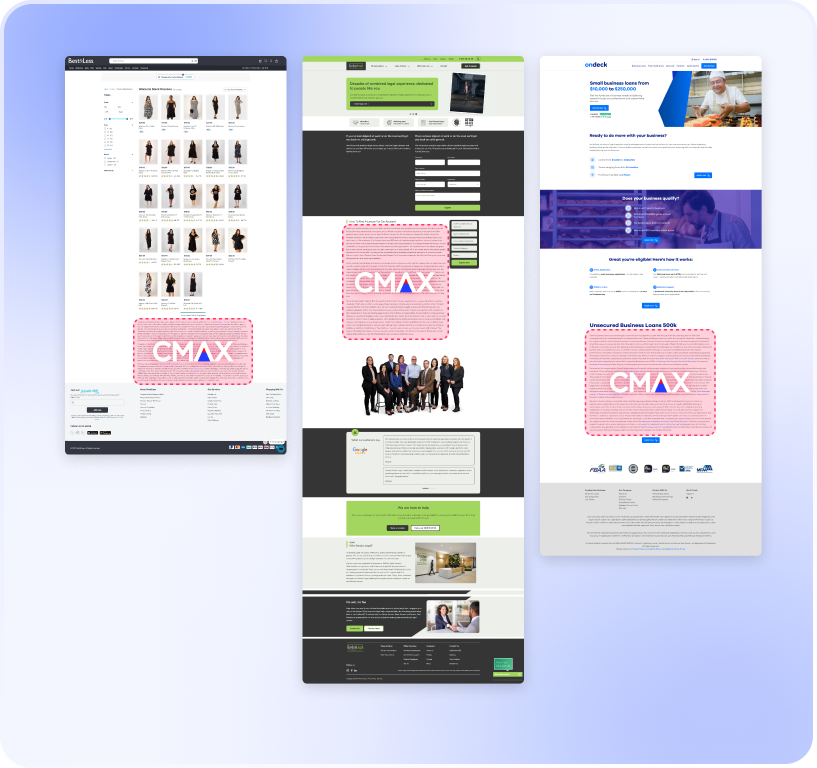
In one CMAX engagement, a B2B omnichannel hospitality retailer published 5,000 long-tail product pages and recorded a 255% organic traffic increase within 12 months. The mechanism was specific: keywords mined from SEO and Google Ads data, combined with structured product information, built each page around documented demand rather than assumed topics.
That result holds a broader lesson for SEO automation at any scale. Across the SEO aus landscape, review rules matter more than page count. Large query sets, structured page inputs and repeatable review rules make catalogue-scale publishing easier to control than one-off manual production, because the standards are codified rather than carried in someone’s head.
SEO automation at catalogue scale shares much of its operating logic with an SEO agent, where a defined set of rules, structured inputs and review checkpoints govern each page decision rather than leaving quality to individual judgment calls.
A simple checklist makes automation boundaries easier to set.
SEO Automation Self-Assessment Checklist
Before adding any task to an automated workflow, score it against five criteria. A task that clears all five is a strong candidate. One that fails two or more probably needs a human in the loop.
Cadence. The task runs on a predictable schedule: weekly reporting, recurring rank checks, scheduled crawl reviews. If it only happens when someone remembers to trigger it, the automation has no reliable rhythm to attach to.
Input structure. The inputs can be standardised: keyword sets, page templates, schema fields, issue categories. Vague or inconsistent inputs produce vague or inconsistent outputs, regardless of how well the tool is configured.
Reviewable output. The output can be checked against clear rules: search intent fit, factual accuracy, link relevance, issue severity. If approval depends entirely on personal preference or brand instinct, the task resists systematic review.
Reversible errors. A mistake can be caught and corrected before it creates a publishing, legal or reputational problem. High-stakes outputs with no recovery path warrant manual handling until the process is proven. Teams weighing automation services Australia providers should apply this same reversibility test before outsourcing any task that touches live pages.
Meaningful volume. The task generates enough recurring work that automation removes a real labour burden. Automating a task that takes ten minutes a month frees up almost nothing; automating one that consumes several hours a week compounds quickly across a small team.
The checklist scores each task to decide whether SEO automation is the right fit. Once a task clears all five criteria, teams can evaluate the best SEO automation tools available for that specific workflow rather than defaulting to a single platform.
SEO automation decisions become clearer when teams score each task against the same criteria used in AI based SEO frameworks, such as data structure, review risk and whether outputs can be checked against known rules rather than subjective preference.
A human owner can approve exceptions, edge cases and final changes before publication, escalation or stakeholder reporting.
Start with Low-Judgement Tasks
Automate high-volume, low-judgement tasks first. Rank monitoring, scheduled crawls, keyword clustering and recurring reports are the right starting point because the inputs are structured, the outputs are checkable and errors surface quickly without damaging published content.
Teams ready to extend into SEO automation with AI should confirm that quality checks, exception handling and reporting hold up before expanding. If a cluster of pages is misfiring on search intent, or a crawl report is routing issues to the wrong owner, those are signals to pause and fix the review layer before adding more volume.
A human owner still needs to sit at the end of the workflow. That person approves exceptions the automation flags but cannot resolve, signs off on edge cases where page purpose or brand judgement is genuinely ambiguous, and reviews final outputs before they go to stakeholders or live publication. Automation handles the repeatable work; the human owner handles the decisions that carry real consequences if they go wrong.
SEO automation can be extended further by deploying SEO agents to handle exception routing, issue escalation and recurring audit checks once quality controls and ownership rules are confirmed to be holding up at scale.
That division keeps the workflow defensible. Teams that skip the human approval layer often find that small errors compound at scale, and fixing them after publication costs more time than the automation saved. Build the review checkpoint in from the start, not as an afterthought once volume has already grown.
Can automated SEO cause Google penalties?
Automated SEO creates risk when pages are published at scale primarily to manipulate rankings or when they add little original value. Google’s spam policies target thin, duplicative content regardless of how it was produced.[2] Teams that define page purpose upfront, run originality checks and require human review before publication stay on the right side of those policies. The mechanism that produces the page matters far less than whether the page serves a real search need.
Does SEO automation hurt content quality?
SEO automation does not automatically reduce quality when inputs and review are in place. Quality drops when teams automate drafting with vague inputs, skip factual checks, ignore duplication and publish without editorial approval. Teams running SEO Sydney campaigns often ask whether automation weakens local relevance, and the answer is the same: tighten the inputs, add a review checkpoint and quality holds.
How to measure automated SEO ROI?
Compare workflow cost against time saved, issues resolved, pages shipped, organic traffic growth, conversions and revenue contribution. Report efficiency gains and business outcomes separately so it’s clear whether the process is saving labour, driving performance, or both. For teams managing SEO Brisbane programs, that split is especially useful when presenting results to a CFO or board who want to see regional return on investment.
How many automated pages can Google index?
There is no fixed page limit for automated content. In our experience, indexation tends to depend on crawlability, internal linking, uniqueness, usefulness and real demand for the query, rather than on whether software helped produce the pages.
SEO automation workflows are also being re-examined in light of AI search engines, since pages built around structured inputs and clear search intent tend to perform more consistently across both traditional and AI-driven results.
How to automate enterprise SEO audits?
Schedule recurring crawls, classify findings into fixed issue types, route each issue to an owner and track resolution trends over time. As a practical example, agencies offering SEO Perth services use this structure to give teams a repeatable operating rhythm rather than a reliance on one-off manual reviews that only happen when someone has capacity.
SEO Automation at Scale, Built for Teams That Can’t Afford to Wait
CMAX is an agentic SEO platform purpose-built for programmatic content deployment.
Our AI agents target long-tail keywords, the thousands of specific, high-intent queries most strategies leave on the table, and continuously update pages as search behaviour shifts. Two lines of code connect CMAX to your site; from there, the platform handles research, content creation, and optimisation at a speed and scale manual teams simply can’t match. Every piece of content strengthens the broader network, capturing more traffic as it grows.
The result is measurable organic growth without the headcount trade-off that stalls most in-house programs.
References [1] – https://developers.google.com/search/docs/essentials/spam-policies [2] – https://developers.google.com/search/docs/essentials/spam-policies
Author
Jeremy Tang
Founder and CEO of CMAX
Jeremy Tang is the Founder and CEO of CMAX. With over 2 decades of experience in business consulting and digital marketing, he has successfully driven seven startup businesses, six of which achieved $1 million in revenue from zero in less than 16 months, 5 of which grew to multi-million dollar a year ventures without any external funding. Jeremy's expertise lies in streamlining business processes through technology and leveraging digital (in particular SEO) for business growth. He resides in Australia, travels extensively, and draws inspiration from his global experiences.