Most SEO agents promise scale but skip the part where your team actually stays in control. The gap between “we automate content” and a workflow with approval gates, source validation, rollback, and performance reporting is where enterprise programmes stall or break. If you’re evaluating platforms for long-tail page generation across large product, location, or service sets, the question worth answering first is what the system produces at each stage and who signs off before anything publishes. CMAX is one platform built around that kind of structured, auditable execution.
Enterprise SEO agents earn their place through controlled execution.
Agents vs writing tools
What separates SEO agents from writing tools is that they execute a defined workflow end to end. A writing tool returns text from a prompt. An SEO agent executes a defined workflow: it takes an approved search objective, generates briefs, maps source inputs, produces drafts, runs QA checks, records approvals, and reports on outcomes. The distinction is operational. A writing tool hands you an output and stops. An agent moves a page from objective to published result through a sequence of accountable steps, each of which can be inspected, approved, or halted.
For enterprise teams managing hundreds or thousands of pages, that difference is what makes automation defensible. A prompt-based tool scales your drafting. An agent scales your process.
SEO agents represent a meaningful shift in how search work gets done, and the broader relationship between AI and SEO helps teams set realistic expectations for what end-to-end workflow execution actually involves.
Approval and rollback controls
Controlled execution means the workflow has checkpoints, not just outputs. Any AI SEO workflow at scale needs approval gates before any page set publishes, revision history that shows what changed and when, and rollback controls that let a team reverse a bad release cleanly.
When evaluating platforms in this category, it helps to know what a single SEO agent is expected to own, from interpreting a search objective through to publishing an approved page and recording the outcome, before assessing how that capability scales across an enterprise SEO workflow.
Without those safeguards, a single template error, a stale data field, or a duplicated block can propagate across hundreds of URLs before anyone catches it. The damage is not just content quality; it is indexing problems and search loss that take months to recover. Approval and rollback controls are the mechanism that keeps scale from becoming a liability.
The Strongest Platforms Handle Scale Without Sacrificing Oversight
Best-Fit Long-Tail Use Cases
A business targeting SEO Melbourne alongside SEO Sydney, SEO Brisbane, and SEO Perth faces dozens of location-query combinations that manual page creation rarely covers. Long-tail page generation earns its place when a site carries large product catalogues, location combinations, or service variations that each map to distinct queries with different intent.[1] A standard category-page strategy covers the obvious demand. It leaves a meaningful share of real search volume without a dedicated page. That gap is where SEO agents operate most effectively: converting structured catalogue data into page sets that address specific queries a single category page was never built to serve. SEO agents coordinate the full production pipeline across large page sets, and part of that pipeline often involves briefing or reviewing the work of an SEO content writer to meet query-specific requirements before QA begins.
Common Automation Failure Points
Automation breaks in predictable places, and the failure modes are worth naming before evaluating any platform. Source data that is missing or stale produces pages built on bad inputs. An SEO agency for startups or an SEO agency for saas that relies on stale source data will produce pages that miss the specific queries each audience actually searches. Factual claims that are never validated against approved material create accuracy risk at volume. Templates that repeat with too little query-specific variation generate thin pages that add crawl load without adding search value. Indexing left too open compounds the problem, producing large sets of low-priority URLs that dilute the stronger pages already ranking. SEO agents are most effective when they operate within a governed framework, and SEO automation handles the repeatable, high-volume tasks, such as brief generation, template population, and QA checks, that would otherwise bottleneck a team managing thousands of long-tail pages.
AI SEO Agent Stage Checklist
A workable enterprise process is visible at every stage. Use this as a baseline when evaluating any platform:
- Input scope matches a defined search pattern set, product attributes, locations, or service variants, with a clear page model behind it.
- Source data is mapped before drafting: approved fields, exclusions, freshness checks, and explicit rules for what the workflow must never invent.
- Content briefs specify target query groups, page purpose, required entities, internal link targets, and the page differences that make each template output distinct.
- Drafts pass QA for factual accuracy, duplication risk, missing template logic, thin sections, and brand or compliance issues before any publishing step.
- Publishing requires human approval, with version control and rollback available so teams can inspect change history and reverse a bad release.
- Indexing rules separate pages worth surfacing in search from pages that should stay crawlable but unindexed, preventing index bloat from overwhelming stronger page types.
- Reporting groups performance by page type or query cluster so SEO agents can identify which patterns earn impressions, clicks, and conversions, and which need revision.
Meaningful evaluation depends on workflows, safeguards, and measurement.
Workflow signals worth seeing
Worthwhile SEO agents expose inspectable workflow outputs such as briefs, source mapping, and QA logs.[2] An SEO agency dashboard should surface briefs, QA logs, and approval checkpoints rather than hiding them behind a single status label. That visibility lets a team trace exactly how each page was assembled and pinpoint where an error entered the workflow. If a factual claim is wrong or a template fires incorrectly, the audit trail tells you which input was bad, which QA step missed it, and which approval gate let it through. Without that, fixing problems at scale becomes guesswork.
SEO agents sit within the wider practice of AI based SEO, where the quality of outputs depends not on automation alone but on the structured inputs, approval checkpoints, and QA logic that govern what gets published and measured.
Usefulness and oversight matter most
Scaled content holds up when each page serves a distinct query with original utility and stays under human review. The practical risk is publishing inaccurate, repetitive, or low-value pages at volume. Automation is the delivery mechanism; human judgment is what keeps the output defensible. Pages that answer a real, specific search need with accurate, source-validated content are far less exposed to quality-related ranking loss than pages that exist only to fill a template.
Small-site workflow example
The same principles apply at any scale. A firm positioning itself as an SEO agency Melbourne or SEO agency Darwin can use one approved brief to build a controlled page set for each location. Those pages are then selectively indexed by page type, keeping low-priority URLs out of the index while stronger pages surface in search. Search Console data, grouped by query cluster, then shows which patterns earn impressions, clicks, and conversions, and which ones need revision before any further expansion is considered.
A confident shortlist comes from proof, not claims.
Evidence that makes a platform usable
Ask any platform to show you repeatable outputs before you commit. That means actual briefs, source mapping records, QA logs, approval checkpoints, and performance reports tied to specific page sets. Broad claims about automation, scale, or ease of use tell you nothing about how the system behaves when source data is incomplete or a template produces near-duplicate pages at volume.
Evaluating SEO agents becomes easier when platforms show repeatable outputs tied to rankings and conversions. The evaluation criteria that hold up are concrete: Can the platform show rankings movement by page type? Does it attribute qualified traffic and conversions to specific query clusters? Can it surface page-level learnings that tell you which patterns to expand and which to pull? If a vendor can’t demonstrate those outputs from a real engagement, the governance story is probably thin too.
SEO agents generate measurable value when their outputs are tied to clear performance data, and automated SEO reports are one of the key deliverables that allow enterprise teams to track which page patterns are earning impressions, clicks, and conversions over time.
Enterprise-scale proof point
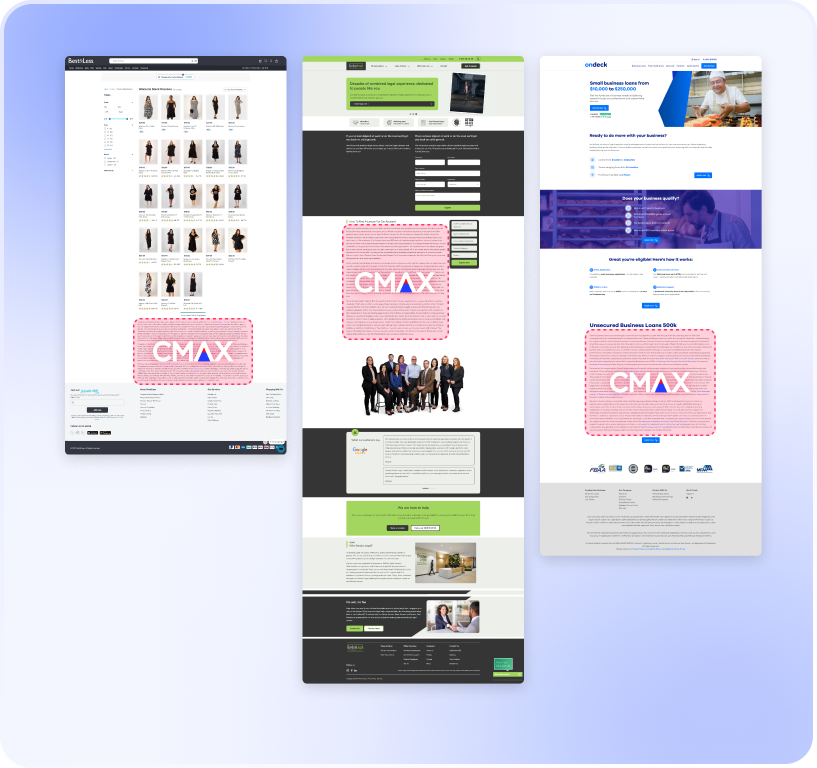
In one CMAX engagement, a B2B omnichannel hospitality retailer added 5,000 long-tail product pages and drove over $1M per month in incremental SEO revenue within 8 months. That result came from catalogue-scale long-tail demand that manual SEO output had left uncovered.
Based on CMAX’s client portfolio, teams managing SEO Australia portfolios with large product or location sets face catalogue-scale long-tail demand that manual output rarely covers. The same gap exists across enterprise teams managing large product sets, location combinations, or service variants. The demand is real. The pages rarely exist. And the difference between a platform that captures it and one that creates index bloat comes down to the governance and measurement controls covered in the sections above.
How do AI SEO agents measure ROI?
AI SEO agents measure ROI by linking page groups to outcomes: incremental impressions, clicks, qualified sessions, conversions, and revenue or pipeline where first-party attribution exists. That framing lets teams judge which page patterns create business value rather than which ones simply add indexed URLs to a crawl report.
Will AI-generated content get penalised?
Content is more likely to underperform when it is inaccurate, duplicative, or unhelpful.[3] AI-assisted content that is reviewed, grounded in approved inputs, and built for a clear search need can still rank. The risk is in the process, not the label.
SEO agents are increasingly being evaluated not just for traditional search performance but also for how well their outputs are structured to appear in AI search engines, where answer-based retrieval rewards well-organised, factually grounded content.
How do AI SEO agents keep brand voice?
Brand voice is maintained by training workflows on approved brand assets, setting explicit rules for tone and terminology, and requiring review before new templates or page types are published at scale. Governance at the template level is what holds voice consistent across thousands of pages.
How do AI SEO agents handle compliance?
Compliance is handled by restricting inputs to approved source material, applying rules for prohibited claims or wording, and routing sensitive page types through human approval before publication. Where regulated language or legal review is required, that approval step is non-negotiable.
How do AI SEO agents ensure quality at scale?
Quality at scale for SEO agents depends on structured source data and template logic that creates meaningful page differences. Automated QA checks for factual and duplication issues add another layer of control. Reporting then shows which page patterns should be improved, expanded, deindexed, or removed, so the system gets sharper over time rather than just larger.
CMAX Built for the 90% of Search Traffic You’re Not Capturing
Most SEO platforms target the same high-volume keywords everyone else is fighting over.
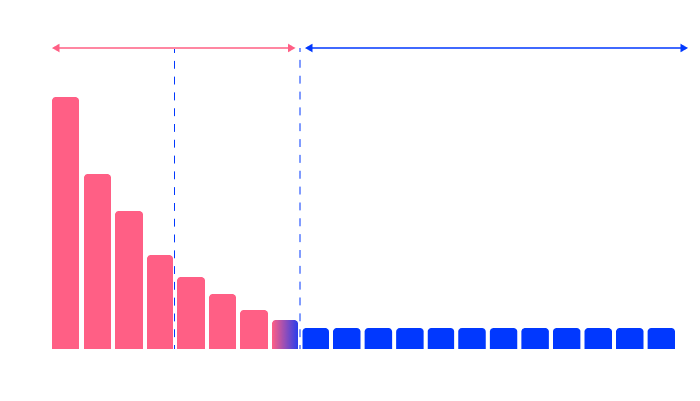
CMAX is an agentic SEO platform that deploys with two lines of code and targets thousands of long-tail keywords, the 90%-plus of search and AI demand that conventional strategies leave on the table. Its AI agents continuously create, update, and optimise content at a scale and speed manual teams can’t match, turning each page into another node in a growing traffic network. Results typically begin within six weeks.
If you’re evaluating SEO agents for scalable, measurable organic growth, CMAX is built precisely for that use case.
References [1] – https://ahrefs.com/blog/long-tail-keywords/ [2] – https://developers.google.com/search/docs/fundamentals/creating-helpful-content [3] – https://developers.google.com/search/docs/essentials/spam-policies
Author
Jeremy Tang
Founder and CEO of CMAX
Jeremy Tang is the Founder and CEO of CMAX. With over 2 decades of experience in business consulting and digital marketing, he has successfully driven seven startup businesses, six of which achieved $1 million in revenue from zero in less than 16 months, 5 of which grew to multi-million dollar a year ventures without any external funding. Jeremy's expertise lies in streamlining business processes through technology and leveraging digital (in particular SEO) for business growth. He resides in Australia, travels extensively, and draws inspiration from his global experiences.