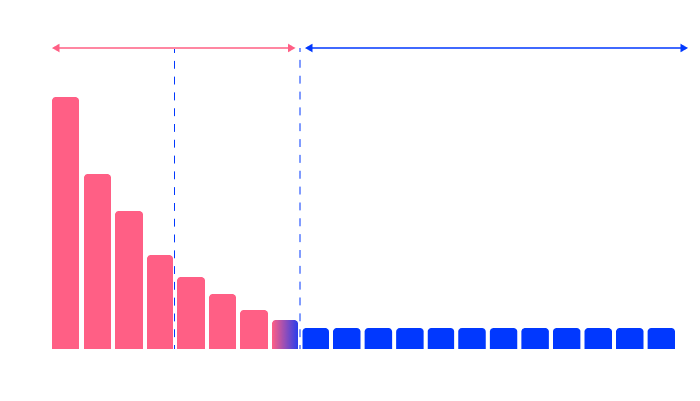
Long tail keyword research usually produces the same result: a spreadsheet with hundreds of low-volume queries and no clear way to decide which ones deserve a page. The problem is rarely discovery. Most teams can pull terms from Search Console, autocomplete, and paid search reports without much effort. Where things stall is prioritisation, figuring out which queries justify new content, which belong on existing pages, and which should be dropped entirely. That workflow, from raw query list to validated keyword map, is what separates productive research from busywork. It’s also where teams using CMAX at scale have seen the clearest gains.
Long tail keyword research fails when lists outgrow decisions.
Most long tail keyword research projects stall at the same point: a spreadsheet with hundreds of queries and no clear basis for choosing between them. Volume alone does not resolve that. Neither does difficulty. The list grows; the roadmap does not. For teams asking what is a long tail keyword worth targeting, the answer starts with decision criteria, not list length.
What Makes a Long Tail Useful
A useful long tail keyword does three jobs at once. It reveals a recognisable intent, something a real person is trying to do, buy, or resolve. It maps to something the business can genuinely answer or sell, so the page has a credible reason to exist. And it supports a distinct URL that can win qualified visits rather than accumulating impressions from searchers who will never convert.
A keyword that clears all three tests earns a place on the roadmap. One that clears only one or two is a candidate for consolidation or removal. These three checks apply to all long tail keywords, regardless of search volume or competitive difficulty.
Long tail keyword research is the discovery and validation layer that underpins longtail SEO as a whole, so that every term added to a roadmap has passed intent, relevance, and page-need checks before earning a dedicated URL.
When Low Volume Becomes Vanity
Low volume is not the problem. Misaligned low volume is. A term stops being an opportunity when it duplicates an intent already covered by another target page, sits outside the site’s commercial or topical scope, or fails the page-need test because the right answer already lives on an existing URL.
Publishing a new page for a query that an existing page already satisfies splits authority without adding value. Many teams wonder what are long tail keywords actually doing for them when half the list duplicates existing coverage. The discipline is not in finding more queries, it is in rejecting the ones that cannot justify a page of their own. That filter is what separates a prioritised keyword map from a list that never ships.
A repeatable workflow turns raw queries into a prioritised keyword map.
Long-Tail Prioritisation Workflow
A repeatable long tail keyword research workflow works because every query passes through the same sequence before it earns roadmap space: discovery, validation, scoring, clustering, and live testing. Skipping a stage is where lists grow and decisions stall.
Discovery. Pull queries from Search Console, paid search term reports, autocomplete, related searches, and customer language from support tickets or sales calls. Each source exposes a different form of intent. Search Console shows live impression data. Support tickets and sales calls surface problem-led phrasing that keyword tools rarely surface on their own.
Clean the list. Remove duplicates and obvious mismatches so the working list contains only terms the site can credibly cover, products, services, or publishable topics within its actual scope.
Validate. Check each term for search intent, likely page type, and topical fit. The key question: would a dedicated page serve this query better than an existing category, service, or blog URL? If the best answer already lives somewhere on the site, a new page adds noise.
Score. Weight business relevance, conversion potential, ranking feasibility, and demand together. Disciplined long tail keyword research treats volume as one input, not the deciding factor. A modest-demand term with strong commercial fit and low competition can outperform a high-volume term the site has no realistic path to rank for.
Cluster and split. Group close variants under one page target. Split only when the wording signals a different use case, audience, comparison need, or stage of the buying process, because those shifts change what the page needs to prove.
Publish a pilot group, then review indexed URLs, impressions, clicks, and the spread of actual queries in Search Console before expanding the cluster pattern further.
Best Sources for Intent Variants
A long tail keyword research tool is only as useful as the intent data fed into it. Broad seed terms are a starting point, not a research strategy. The intent variants that matter most surface in sources that capture real search behaviour after that initial query breaks into narrower problems, comparisons, and use cases.
Search Console is the highest-signal source available. The queries report shows exactly how people phrased a search before landing on, or scrolling past, a page. Paid search term reports serve the same function for teams running Google Ads: the actual terms triggering spend often reveal commercial intent variants that organic research misses entirely.
Autocomplete and related searches extend the picture. Both reflect aggregated query patterns, so they tend to surface the specific jobs-to-be-done language that searchers use when they move from a general topic toward a decision. A query like “project management software” breaks into “project management software for construction teams” or “project management software vs spreadsheets”, each a distinct intent, each a potential page target.
Customer language from support tickets and sales calls adds a layer that no long tail keywords finder replicates. When a prospect asks a sales rep “does this work for multi-site retailers?” that phrasing is a keyword candidate. It reflects a real objection at a specific stage, and a page built around it can intercept that question before the sales conversation begins.
Each source exposes a different form of intent. Using all of them together produces a working list that reflects how demand actually distributes across a topic, rather than how a seed keyword tool approximates it.
Validation Depends on Demand, Difficulty, and Page-Level Relevance
Score Keywords as One Decision
Reliable long tail keyword research treats volume as one input, not the deciding factor. A keyword pulling 200 monthly searches can outperform one pulling 2,000 when it maps cleanly to a specific page type, faces weaker competition, and sits closer to a conversion decision.
Priority scoring becomes more reliable when four factors are weighted together: intent clarity, topical fit, ranking feasibility, and conversion value. A term with modest demand but strong topical alignment and a clear page format is often the better bet than a high-volume query that requires a page the site cannot credibly build or rank.
The practical output is a scored list where each keyword carries a composite rating rather than a raw volume figure. That rating reflects what the site can actually win and what a win is worth commercially.
Catalogue-Scale Validation Example
The same logic scales. In one CMAX engagement, a B2B omnichannel hospitality retailer launched 5,000 long-tail product pages built from SEO and Google Ads query data.[1] Organic traffic increased 255% over 12 months.
The mechanism was systematic: queries were validated for demand and relevance, clustered by intent, and matched to specific page types before any URL went live. The traffic gain came from making thousands of individually small opportunities visible and actionable, not from chasing a handful of head terms.
Long tail keyword research at enterprise scale often feeds directly into SEO dynamic content strategies, where validated clusters are used to generate and populate page templates across large catalogues rather than being built out one URL at a time.
For enterprise sites with large catalogues, this is where long tail keyword research pays off. Valuable demand sits beyond the obvious seed terms and only surfaces after validation, clustering, and deliberate page-level targeting are applied at scale.
Clusters Win When Each Page Serves a Distinct Search Job
Group Similar, Split Meaningfully
Near-duplicate queries, terms that share the same intent, expected page type, and conversion path, belong on one page. Splitting them creates competing URLs that dilute authority and confuse crawlers about which page should rank.
The split decision triggers when the wording signals something materially different: a different audience, a comparison angle, a format expectation, or a stage in the buying process. “Project management software for agencies” and “project management software for construction teams” share a seed term but need different proof, different use cases, and a different conversion argument. One page cannot satisfy both without becoming a catch-all that satisfies neither.
When those signals appear, a split is warranted because the content structure, the objections to address, and the call to action will all change.
Applying long tail in SEO at catalogue scale often surfaces the same clustering challenges addressed in faceted navigation SEO, where multiple filter combinations generate overlapping URLs that must be carefully split or consolidated to avoid competing for the same search job.
Why Use-Case Clusters Outperform
A page built around one specific scenario has a structural advantage over a broad target. It can mirror the exact query language, address the objections that matter for that scenario, and attract internal links from pages that share the same use case rather than generic category links.
A catch-all page trying to serve multiple intents at once tends to rank weakly for all of them. A tightly scoped use-case page gives search engines a clear signal about what job it performs and gives the reader a direct answer to the specific question they arrived with. That precision is what drives qualified visits rather than impressions that never convert, and it is the reason long tail keywords for SEO consistently outperform broader terms in conversion rate.
Long tail keyword research provides the validated cluster map that programmatic content relies on to generate pages at scale without duplicating intent or producing thin URLs that fail to serve a distinct search job.
Testing Proves Whether a Prioritised Cluster Can Attract Traffic
Measure Pilots Before Scaling
Before scaling, long tail keyword research needs live performance data to confirm the cluster pattern works. Rather than rolling out a full cluster across dozens or hundreds of URLs, publish a representative pilot group and let Search Console tell you whether the approach is delivering.
The earliest signals to watch are indexation, impressions, clicks, and query spread. If the pilot URLs index promptly and start accumulating impressions, that confirms Google is reading and categorising the pages. When clicks follow, and when Search Console begins surfacing matching queries beyond the exact targets you built for, the page pattern is pulling in adjacent intent, a reliable sign the cluster logic holds before you commit to a wider rollout.
Volume at this stage is less telling than breadth. A pilot page earning impressions across ten related query variants is more informative than one earning high impressions on a single term, because the spread shows the page is satisfying a recognisable intent rather than ranking on a narrow match.
Long tail keyword research can inform the input layer of automated SEO systems, but the pilot measurement stage, tracking indexed URLs, impressions, and query spread in Search Console, still requires human judgement to confirm whether the cluster pattern is earning genuine visibility before a wider rollout.
What Humans Must Still Validate
AI-assisted research can accelerate query collection and first-pass drafting. What it cannot do reliably is judge live SERP intent, catch false synonyms that look related but serve different needs, or decide whether a proposed page split is genuinely justified by a distinct use case.
Long tail keyword research increasingly intersects with the broader conversation around AI and SEO, particularly when evaluating whether AI-assisted query collection tools can reliably surface pilot-worthy clusters before human validation begins.
Those calls require a human. Before any URL enters production, someone needs to check the live SERP for each target, confirm the page type matches what Google is already rewarding, and verify that the new URL will not compete with an existing page for the same search job. Thin or overlapping pages that slip through that check create cannibalisation problems that are slower to fix than they are to prevent.
Do long tail keywords convert better?
Long tail keywords often convert at a higher rate than broad terms when the wording reveals a specific need, comparison point, or buying stage. A searcher using a precise query is typically closer to a decision than one using a broad exploratory term, which means a page built to answer that narrower question meets them at the right moment with the right proof.
Are long tail keywords easier to rank for?
They can be, when competition is lower and the keyword maps cleanly to a dedicated page. That advantage disappears when the SERP is held by stronger domains, specialist content, or intent patterns your site does not yet satisfy. Lower volume does not automatically mean lower difficulty.
How to avoid long tail keyword cannibalization?
Merge near-identical intents into one target page. Split queries only when they require materially different content, structure, or a different conversion path. Keep internal linking, titles, and page purpose tightly aligned so multiple URLs are never competing for the same search job.
How to measure ROI for long tail SEO?
Connect each cluster to the business outcomes it is meant to influence: indexed pages, qualified organic sessions, assisted conversions, leads, revenue, or reduced paid search spend. Traffic growth alone is not the result; it is one signal within a broader commercial picture.
Do AI overviews affect long tail search traffic?
AI Overviews can absorb some informational clicks, particularly for queries with a clear, concise answer, though this represents an observed tendency rather than a universal system behaviour. Pages that offer deeper detail, original evidence, product-level specificity, or formats an overview cannot replicate retain their openings in the SERP.
Long tail keyword research workflows may need to account for how AI search engines handle query interpretation differently from traditional results pages, since intent signals and click behaviour can diverge across platforms.
Most Teams Have the Keywords, They Lack the Prioritisation
Long tail keyword research doesn’t stall at discovery. It stalls at deciding what to publish next.
CMAX is an agentic SEO platform built to close that gap. It deploys AI agents that score, cluster, and produce content across thousands of long tail variations, targeting the high-intent searches most strategies leave on the table. Results from deployed campaigns typically begin surfacing within six weeks.
If your keyword lists keep growing but your organic traffic doesn’t, that’s the problem CMAX was designed to solve.
References [1] – https://ahrefs.com/blog/long-tail-keywords/
Author
Jeremy Tang
Founder and CEO of CMAX
Jeremy Tang is the Founder and CEO of CMAX. With over 2 decades of experience in business consulting and digital marketing, he has successfully driven seven startup businesses, six of which achieved $1 million in revenue from zero in less than 16 months, 5 of which grew to multi-million dollar a year ventures without any external funding. Jeremy's expertise lies in streamlining business processes through technology and leveraging digital (in particular SEO) for business growth. He resides in Australia, travels extensively, and draws inspiration from his global experiences.