SEO dynamic content means pages that update or generate themselves based on data, location, or what a customer is searching for, and whether Google can actually see and index those pages. Most retailers already have the products, variants, and locations to support this.
They just haven’t turned them into pages that match how customers search.
The challenge is creating pages that are distinct and useful, not creating more pages for the sake of it. Near-identical pages confuse Google and can trigger content cannibalisation, where your own pages compete against each other and none of them win.
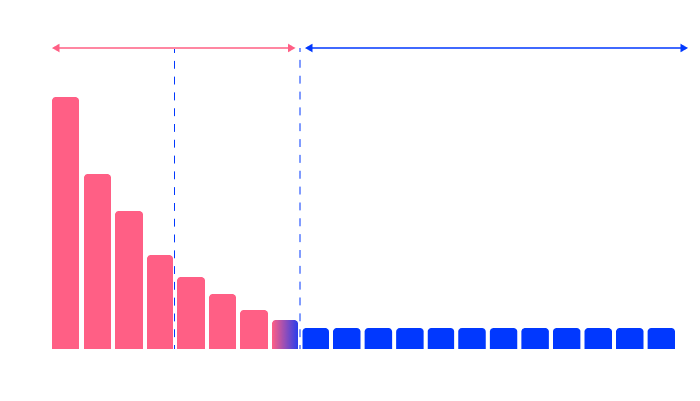
Get the basics right and you start capturing the long tail, the specific, detailed searches people actually type, instead of fighting over a handful of broad terms where competition is fiercest.
SEO dynamic content helps capture specific searches at scale.
Accessible HTML, distinct intent.
Think of Google’s index, its catalogue of pages it knows about, as a librarian who can only file books written in plain language. If your pages are assembled by JavaScript after the page loads, the librarian may arrive before the book is finished and leave empty-handed.
This is the core problem with JavaScript SEO: dynamic content only performs when each page renders into readable HTML before Google’s software comes back to read it.
Each URL also needs one clear reason to exist, a location, a product variant, a use case, a pricing question. That clarity is why SEO and content strategy matters before you publish at scale.
Without it, search engines are forced to guess which of your near-identical pages to show, and they often choose none of them.
Adding structured data SEO markup, the machine-readable labels that tell Google what a page is about, helps at this point too. SEO structured data gives search engines a reliable signal when the page content itself is generated from templates.
Think of it as a label on a jar: the contents might vary, but Google knows exactly what it’s looking at. What is dynamic content, in practical terms, is a page whose output changes based on data inputs while its structured signals stay consistent.
Long-tail coverage at scale.
Dynamic content personalisation builds visibility across the many specific ways buyers phrase the same need, rather than betting on a handful of broad terms. Google sees roughly 15% brand-new searches every day.
New wording, niche use cases, and emerging questions keep appearing. A static set of pages cannot keep pace with that, which is the core commercial argument for dynamic content and SEO.
Quality, freshness, and internal links determine whether it performs.
Avoid thin or duplicate pages.
A generated page only helps when it adds something a blank template cannot: live inventory detail, suburb or branch context, pricing logic, or a direct answer to a specific question. Thin content SEO is the failure mode here.
Google explicitly warns against programmatic content that produces pages with little or no original value, and a thousand pages saying almost the same thing qualifies, regardless of how sophisticated the system that produced them.
Live inventory detail and suburb-specific information are what separate a useful page from a page Google ignores.
Keep pages connected and current.
Internal links do two things. They help Google find related pages, and they signal which pages carry the most weight.
That matters when dynamic content creates hundreds of entry points across a site. Pages left unreviewed also drift out of sync with stock, pricing, and the way customers search, so content pruning SEO is not optional maintenance, it is part of the system.
Content freshness SEO means keeping generated pages current with pricing, policy, and stock rather than publishing once and moving on.
We turn dynamic content into a continuously updated system.
Scaled creation with human review.
CMAX is the Agentic SEO Platform, built to scale automated content generation with human review and approved brand inputs. Dynamic content SEO reflects your actual products, pricing, and tone, not unattended template output that drifts off-brand over time.
Our agents generate content trained on your approved brand assets, preventing hallucinations and off-brand output.
Coverage, governance, and ongoing updates.
We target the 90% of search demand in the long tail, using Full Body SEO and SEO content gap analysis to build content surface area, the number of customer searches your site has a useful answer for, across the specific searches buyers actually use.
Unlike static publishing, dynamic content stays current through Dynamic Internal Linking and Smart Optimisation as new searches and market shifts appear. Website content optimisation runs across connected pages as those updates roll through the site.
Clients see first clicks in 6-8 weeks, with programmes maturing around month six.
Frequently Asked Questions (FAQ)
Can personalised dynamic content be considered cloaking?
Personalised dynamic content is not inherently cloaking, provided the page presents materially consistent information to both users and search engines. A crawlable page generated from templates, data, or contextual signals is legitimate SEO dynamic content when its rendered output remains indexable.
Google defines cloaking specifically as showing different content to users and search engines with the intent to manipulate search positions and mislead users.
Can dynamic URLs waste Google’s crawl budget?
Yes, particularly when filters, parameters, or faceted navigation generate large numbers of low-value URL combinations. Crawl frequency, how often Google’s software comes back to read a site, is finite.
Google warns that faceted navigation can create near-infinite URL spaces, cause overcrawling, and slow discovery of new, useful pages when that budget is spent on parameterised combinations instead.
Can dynamic content slow down page loading?
It can, especially when content depends on heavy client-side JavaScript, late API calls, or layout shifts after the page renders. A weak SEO content score often reflects the same quality and performance issues.
Page speed SEO is measured through Core Web Vitals: LCP within 2.5 seconds, INP at 200 milliseconds or less, and CLS at 0.1 or less. Meeting those thresholds keeps dynamic pages fast enough to support a strong page experience signal.
Coverage beats clever.
SEO dynamic content earns its keep when each page answers one clear search. A page that tries to serve a hundred variations of the same vague intent serves none of them well.
Our agents deploy content across the thousands of ways your customers search, then keep checking performance and updating pages so freshness does not lapse. That is the difference between programmatic publishing and agentic: one publishes and forgets, the other keeps learning.
Dynamic Internal Linking and Smart Optimisation keep pages connected as new searches appear.
Query fan-out matters here too. When someone asks an AI tool a question, that tool runs several smaller searches and builds its answer from what it finds.
If your pages do not cover the specific questions in those searches, your brand does not appear in the answer. The SEO content gap analysis process maps those gaps before they cost you visibility.
SEO page speed can deteriorate when scripts, API calls, or layout shifts accumulate, so the platform monitors page performance as part of ongoing optimisation. You still cannot rank for something you do not talk about, and SEO content marketing services depend on covering the subjects your site needs to rank for rather than leaving key demand untouched.
Author
Jeremy Tang
Founder and CEO of CMAX
Jeremy Tang is the Founder and CEO of CMAX. With over 2 decades of experience in business consulting and digital marketing, he has successfully driven seven startup businesses, six of which achieved $1 million in revenue from zero in less than 16 months, 5 of which grew to multi-million dollar a year ventures without any external funding. Jeremy's expertise lies in streamlining business processes through technology and leveraging digital (in particular SEO) for business growth. He resides in Australia, travels extensively, and draws inspiration from his global experiences.