Most marketing teams treat SEO services marketing as a line item that should produce results the way paid media does: spend goes in, traffic comes out. But organic search compounds differently. It builds visibility page by page, and its commercial value often shows up later than stakeholders expect and in reporting layers most agencies never set up. The gap between what SEO actually does inside a marketing mix and what buyers are told to expect is where most agency relationships break down. CMAX works with enterprise teams who need that gap closed before scope, timing, and measurement are agreed.
SEO Services Sit Inside Marketing as a Compounding Organic Channel
SEO Earns Demand Over Time
SEO services marketing builds unpaid visibility page by page. As indexing and ranking improvements take hold, relevant visits can continue arriving without ongoing spend tied to each click. That’s the compounding effect: pages that earn visibility keep working.
Paid media does a different job. Traffic from paid campaigns typically stops when budget stops. SEO, by contrast, accumulates. A well-indexed page that ranks for a qualified query can deliver visits weeks or months after the work that produced it. The two channels aren’t interchangeable, and treating SEO as a paid-media substitute sets the wrong expectations from the start.
SEO services marketing increasingly intersects with AI in search engine optimisation as algorithms evolve to interpret content intent, entity relationships, and user signals at a deeper level than traditional keyword matching alone.
Organic Supports Other Channels
Organic search strengthens the wider channel mix rather than duplicating it. As part of a broader SEO and digital marketing services approach, it captures non-brand queries that paid campaigns often can’t reach cost-effectively, and it creates landing pages built around specific products, services, or use cases that give the rest of the marketing stack more to work with.
Paid, email, and sales teams benefit directly. A prospect who finds a product page through organic search before a retargeting ad or a sales follow-up has already been qualified by intent. SEO creates those entry points at scale, reducing the pressure on paid acquisition to carry all new-demand coverage on its own. When organic is working, the channel mix becomes more efficient across the board. That efficiency is one reason digital marketing SEO services strategies increasingly treat organic as a foundational layer rather than an optional add-on.
An SEO Agency Should Define Workstreams, Limits, and Timing Clearly
What SEO Scope Should Include
A credible SEO services marketing scope names what will be researched, fixed, published, improved, and reported, and it covers each major workstream: keyword research, technical SEO, content production, internal linking, authority work, and measurement. That list is important because each workstream connects to a distinct business effect. Keyword research shapes query coverage. Technical SEO determines what search engines can crawl and index. Content production expands the pages competing for non-brand demand. Internal linking distributes authority and guides users toward conversion. Authority work strengthens page-level relevance signals. Measurement ties all of it back to outcomes.
A business looking for SEO services Melbourne should expect the agency to state scope, timing, and limits before work begins. Every deliverable in a well-written scope should map to one of those effects, better indexation, broader non-brand coverage, stronger page relevance, or clearer conversion paths. If a proposed scope lists activities without stating what each one is expected to change, it’s a task list, not a strategy. A well-defined scope should specify whether SEO content writers are embedded in the programme or sourced separately, since content production velocity directly affects how quickly new pages can be indexed and ranked.
When SEO Signals Usually Appear
Ranking, traffic, conversion, and revenue signals rarely move at the same time, and a reliable agency will say so upfront. Technical fixes can improve crawlability before a single additional click arrives. New pages may get indexed weeks before they rank for target queries. And commercial impact, pipeline, revenue, assisted conversions, can lag well behind visibility gains when approval queues, site constraints, or longer sales cycles slow the path from publication to measurable outcome.
That sequencing is normal. For any team evaluating SEO marketing Melbourne, it is worth scrutinising whether an agency accounts for it in their timeline or papers over it with a single projected traffic number.
Clear Corrections Make Agency Expectations Easier to Assess
SEO Assumption vs Reality Corrections
Separating common assumptions from operational realities lets buyers assess an SEO agency’s scope, timing, and reporting with far more accuracy.
SEO services marketing scope corrections become easier to apply when buyers understand that engaging a SEO copywriting company is one discrete workstream within a broader programme, not a substitute for technical, authority, and measurement disciplines that drive compounding organic growth.
Assumption: SEO is the same job as paid media. SEO services marketing is a discipline that builds organic discoverability compounding as useful pages earn visibility. Paid media buys access to traffic only while budget is active. The two channels do different work and should be evaluated differently. For anyone searching for local SEO marketing services, the same distinction applies: organic local visibility accrues over time, while paid placements disappear the moment spend stops.
Assumption: More activity means better performance. Audits, content, links, and technical tickets carry weight only when they improve indexation, query coverage, qualified visits, or the path from landing page to conversion. Volume of output is not a proxy for commercial progress.
Assumption: Rankings alone prove success. Position changes matter only in context. Non-brand clicks, qualified sessions, assisted conversions, and revenue show whether visibility is turning into commercial value. A ranking report without those signals leaves the most important question unanswered.
Assumption: A serious agency can promise outcomes on a fixed timeline. SEO progress depends on site health, competition, publishing speed, developer capacity, and how quickly stakeholders approve changes. Any agency that commits to specific ranking or revenue outcomes by a fixed date is working around those variables, not accounting for them.
Assumption: Vague deliverables are normal in SEO. Buyers should expect a defined scope, named workstreams, reporting logic, and clear boundaries on what the agency can and cannot control before work starts. A buyer who types SEO marketing near me into a search bar should apply the same standard: evaluate what the agency defines upfront, not how prominently it appears. If that clarity isn’t offered upfront, it’s worth asking why.
Assumption: Vague Deliverables Are Normal in SEO. Reality: Buyers Should Expect a Defined Scope, Named Workstreams, Reporting Logic, and Clear Boundaries on What the Agency Can and Cannot Control Before Work Starts.
Google’s SEO Hiring Guidance
Vague deliverables are not an industry standard. They’re a red flag.
Before signing anything, a buyer should have a written scope that names what will be researched, built, fixed, and reported, along with an honest account of what the agency cannot control. If a proposal lists activities without connecting them to business outcomes, that gap will still be there six months into the engagement.
Google’s own hiring guidance reinforces this. Google advises businesses to look for transparent methods, realistic estimates, and clear explanations of recommended changes before work begins.[1] That guidance applies to any SEO services Australia businesses consider, whether the engagement is local or national in scope. It gives buyers a practical filter: if an agency can’t explain why a recommendation improves indexation, query coverage, or conversion paths, the recommendation has no grounding in how search actually works.
SEO services marketing engagements benefit from the accountability that an enterprise SEO specialist brings when translating Google’s hiring guidance into a defined scope with named workstreams, realistic timelines, and clear boundaries on what can and cannot be controlled.
The same guidance makes it easier to identify what to walk away from. Vague guarantees, methods the agency won’t describe, and recommendations that float free of any search mechanism are all signals that accountability will be hard to establish later.
A credible scope states what workstreams are active, what each one is expected to affect, how progress will be reported, and where the agency’s control ends. Developer capacity, approval timelines, and site constraints sit outside an agency’s direct control. A scope that pretends otherwise sets up a dispute, not a partnership.
Commercial Impact Becomes Visible When Reporting Follows the Funnel
Report SEO Across Funnel Stages
The commercial value of SEO services marketing becomes visible when reporting follows the funnel, separating early signals from commercial outcomes rather than collapsing everything into a single traffic number.
Indexed pages show whether published work is actually discoverable. Non-brand clicks show whether SEO is capturing new demand from audiences who had no prior awareness of the brand. Qualified sessions show whether that traffic has the intent and fit to move further. Assisted conversions and revenue show whether SEO is influencing pipeline, not just generating activity.
Each layer answers a different question. The best SEO marketing services tie every metric to a specific funnel stage, so the commercial story stays complete. A CFO reviewing organic performance needs the full chain, not a subset of it.
SEO services marketing programmes that rely on a SEO content writing company should tie published output to funnel-stage metrics, indexed pages, non-brand clicks, and qualified sessions, so content volume is evaluated by commercial contribution rather than activity alone.
Measure SEO By Channel Role
Attribution becomes more useful when SEO is measured by the role it plays across the full purchase sequence.
Organic search typically introduces the first visit on a non-brand query. The same user may return later through branded search, a direct visit, a remarketing ad, or a sales follow-up before converting. A reporting model that credits only the last touch, or that treats each channel in isolation, can significantly understate what organic search contributed earlier in that sequence.
Measuring SEO by channel role means tracking where it enters the path, not just where it appears at the point of conversion. That framing gives a more accurate read on SEO’s commercial contribution. When SEO services pricing is compared against attributed revenue at each funnel stage, the case for continued investment rests on evidence rather than assumption.
Enterprise Proof Is Strongest When Scale, Method, and Conditions Are Shown
Enterprise Catalogue-Scale Proof Point
In one CMAX engagement, a B2B omnichannel hospitality retailer added 5,000 long-tail product pages and reported $1M+/month in incremental SEO revenue within 8 months, alongside a 255% organic traffic increase over 12 months. Those results came from catalogue-scale long-tail coverage: product-level landing pages built at a breadth and speed that a conventional agency programme cannot replicate through manual publishing.
That dynamic is directly relevant to enterprise buyers who need landing page coverage across large product sets. For a company evaluating SEO services Brisbane, the strongest proof comes from matching catalogue depth to query demand across every product category. When the catalogue runs to thousands of SKUs or service variants, page-by-page production creates a ceiling on how much non-brand query coverage is achievable. Programmatic deployment removes that ceiling.
SEO services marketing at catalogue scale often requires the strategic oversight that enterprise SEO consultants bring when coordinating technical, content, and authority workstreams across large site architectures.
Match Scope to Operating Reality
The most reliable hiring decision comes from matching agency scope, measurement discipline, and market conditions to how your organisation actually operates. Catalogue size, template flexibility, approval workflow, internal resourcing, and growth model all shape what can be shipped, indexed, and measured. A proposal that ignores those constraints will look credible on paper and stall in execution.
Before committing to a scope, pressure-test it against your real publishing pipeline: how quickly can pages move from brief to live, who approves structural changes, and does the agency’s delivery model depend on developer capacity you don’t have on standby. For any team exploring SEO marketing Sydney, those operational details determine commercial outcomes far more than the deliverable list in a deck.
Frequently Asked Questions (FAQ)
What should an SEO analysis report include?
An SEO analysis report should show what search engines can access, which pages are underperforming, which query themes are worth targeting, and where business impact is being lost. In practice, that means indexation status, technical issues, target keyword themes, page-level performance, non-brand organic traffic, conversion data, and a prioritised action list tied to decisions rather than observations alone.
How to measure SEO ROI?
SEO ROI is measured by comparing the revenue or pipeline value attributed to organic search against SEO costs, while separating branded from non-brand performance so existing demand is not mistaken for incremental growth. The useful question is whether SEO created additional commercial value that would not have arrived through brand demand alone.
How can you tell if an SEO agency is driving real results?
A buyer evaluating SEO services marketing should look for a chain of cause and effect in the reporting: more indexable pages, stronger non-brand visibility, higher qualified organic sessions, and movement in assisted or direct conversions and revenue. A task list or a small ranking report cannot show that progression on its own.
How Are Enterprise SEO Services Different?
Enterprise SEO typically involves larger site architectures, more stakeholders, stricter governance, and heavier dependence on templates, internal linking systems, and scalable content operations. The work centres on whether teams can deploy repeatable improvements across large page sets without creating technical or governance bottlenecks.
What SEO Metrics & KPIs Should I Care About?
The most useful SEO metrics and KPIs include indexed pages, non-brand clicks, qualified organic sessions, conversion rate, assisted conversions, revenue, and page-level performance by template or topic. Tracked together, these show whether SEO is expanding discoverability, attracting the right visits, and turning that visibility into measurable business outcomes.
As SEO services marketing adapts to changing search landscapes, practitioners are paying closer attention to SEO for AI search to ensure content remains discoverable across both conventional and AI-driven results environments.
Two Lines of Code, Thousands of Keywords You’re Missing
Most SEO agencies deliver a handful of optimised pages and a monthly report. CMAX works differently.
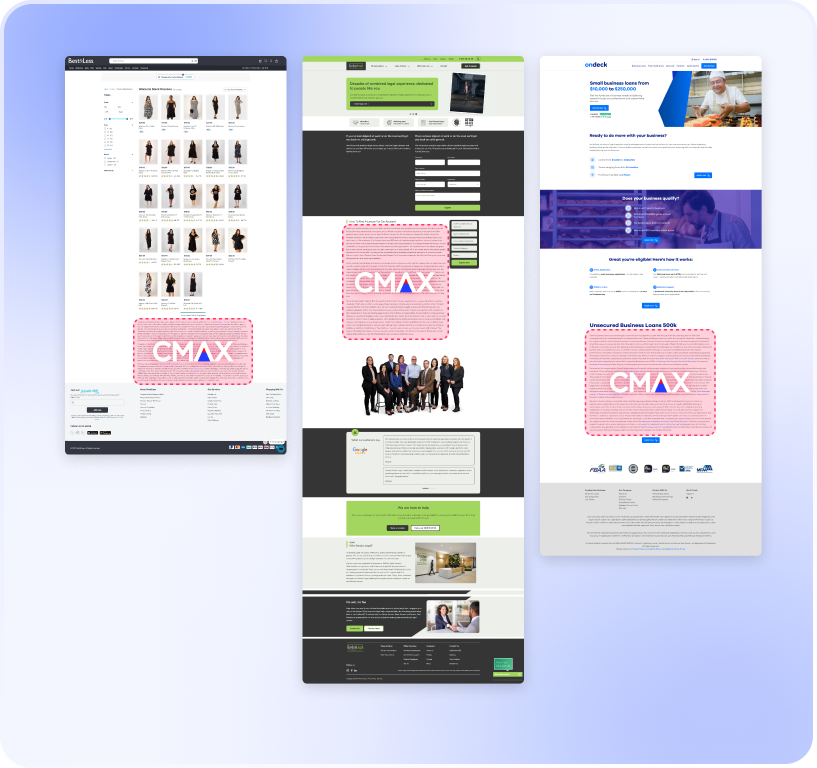
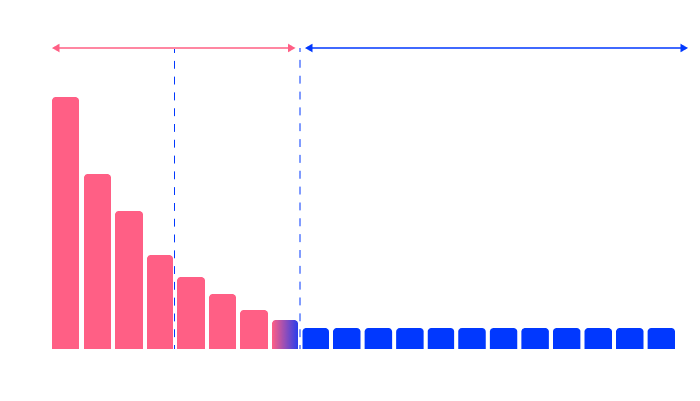
CMAX is an agentic SEO platform that deploys with two lines of code and targets the long-tail keywords where over 90% of search and AI demand sits, based on CMAX platform data across active campaigns. Its AI agents build, publish, and continuously update content for the thousands of specific ways your customers actually search, across both traditional search engines and AI interfaces. Where conventional SEO services add one page at a time, CMAX scales programmatically so organic growth compounds alongside your paid, email, and owned channels rather than competing with them.
Teams typically start seeing measurable results within six weeks, giving you real numbers to bring to a CFO conversation, not just rankings on a slide.
References [1] – https://developers.google.com/search/docs/essentials/spam-policies
Author
Jeremy Tang
Founder and CEO of CMAX
Jeremy Tang is the Founder and CEO of CMAX. With over 2 decades of experience in business consulting and digital marketing, he has successfully driven seven startup businesses, six of which achieved $1 million in revenue from zero in less than 16 months, 5 of which grew to multi-million dollar a year ventures without any external funding. Jeremy's expertise lies in streamlining business processes through technology and leveraging digital (in particular SEO) for business growth. He resides in Australia, travels extensively, and draws inspiration from his global experiences.