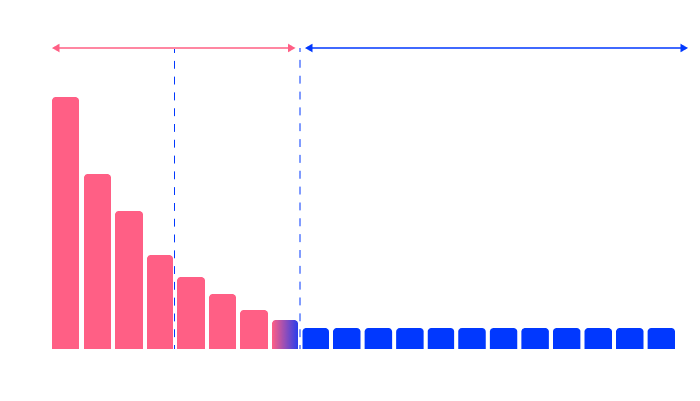
Most people define long tail terms by word count, but a three-word query can be just as long-tail as a seven-word one if it names a specific audience or use case. What actually separates a long-tail term from a head term is how much the searcher has already narrowed what they need. That distinction matters because it changes the kind of page you build and whether it converts. Below, you’ll find a practical way to classify terms by intent, spot the ones worth targeting, and avoid the duplicates that dilute results. CMAX applies this same specificity-first logic when generating long-tail landing pages at scale.
Long-tail terms are defined by intent and specificity.
Specificity Matters More Than Word Count
What makes long tail terms distinct is specificity, not word count. They are typically narrower, lower-volume queries, but word count is a rough heuristic, not a definition. A two-word search like “CRM for dentists” qualifies as long-tail because it names a specific audience and a specific use case. “CRM” on its own does neither. The distinction is intent, not length. A query earns the long-tail label when it narrows the problem enough that a general category page cannot answer it well.
That specificity is what makes long-tail terms commercially interesting. A searcher who types “CRM for dentists” has already filtered by industry. The search itself does part of the qualification work.
Long tail terms become even more valuable as you explore how AI in search engine optimisation is reshaping the way search engines interpret query specificity and intent signals.
Head, Mid-Tail, and Long-Tail Differences
Head terms sit at the broadest end of the spectrum. A query like “CRM” suits a pillar or category page because the searcher has not yet narrowed what they need, which platform, which industry, which budget tier. When searchers refine their queries, they produce long tail keywords that carry more context from the start.
That context changes three things at once: the intent behind the search, the competition on the SERP, and the type of page that can satisfy the query. A head term faces broad competition from authoritative category pages. A long-tail query often faces a thinner, more specific field, and the searcher expects a page that addresses their exact constraint or use case directly. The long tail meaning, in practical terms, describes any query specific enough that only a tightly scoped page can satisfy it well. Matching page scope to query scope is where the opportunity sits.
Long tail terms sit at the intersection of specificity and intent, and learning what is AI SEO clarifies how modern ranking systems evaluate those precise signals beyond simple keyword matching.
Search Intent Explains Why Specificity Can Convert
Broad vs Specific SEO Tool Searches
A query like “SEO tools” sits at the research stage. The searcher has a category in mind but no defined criteria yet, so the SERP reflects that breadth: listicles, category overviews, comparison hubs. A query like “best SEO tools for startups in 2026” is a different problem entirely. The searcher has a budget context, a business stage, and a timeframe. Matching long tail terms like these to a page built for evaluation, with defined selection criteria and direct comparisons, satisfies that intent in a way a general discovery page cannot.
The distinction is not about word count. It’s about how much of the decision the searcher has already made before they type. Long tail terms that reference specific entities or relationships can gain additional visibility when paired with knowledge graph SEO, since structured entity data helps search engines confirm the precise context a narrow query implies.
Query-Specific Pages and Conversion Rates
A strong long tail keywords SEO strategy produces measurable results through tighter page-to-query matching. In one CMAX engagement, a B2B omnichannel hospitality retailer published 5,000 long-tail product pages and saw 204% better Google Ads DSA conversion rates on those landing pages. The mechanism was straightforward: when a page answers the precise product or attribute term a searcher used, the gap between query and content closes. Broad category pages leave that gap open.
The same dynamic applies across any catalogue where searchers use specific product, feature, or attribute terms. Machine learning SEO has accelerated how quickly search engines can detect whether a specific page genuinely satisfies the narrow intent behind a precise query, making tighter page-to-query matching even more critical. For any SEO long tail effort, this rising precision raises the bar for content quality on every dedicated page.
When Long-Tail Terms Underperform
Long tail terms do not improve results by default. Three conditions reliably produce weak outcomes: search demand too thin to justify a dedicated page, multiple pages targeting the same underlying intent, and landing pages that miss the exact question, constraint, or product detail the query implies. Specificity only converts when the page actually delivers on what the query signals.
A simple classification process prevents wasted targeting.
Five Long-Tail Classification Checks
Before building a page around any long tail terms, run them through five checks. Each one tests whether the term genuinely warrants its own page or whether it’s a variation that would dilute rather than extend your coverage.
Real change in intent. Does the modifier shift what the searcher is trying to do, compare, or buy? If the answer is the same as the parent term, the query probably belongs on the same page.
Observable demand. Is there enough search activity to justify production cost? Run candidates through a long tail keywords finder to confirm observable demand before committing resources. A term with thin or zero volume rarely earns its own page, regardless of how specific it looks.
SERP distinctness. Pull the results for both the candidate term and its closest neighbour. If the same pages rank for both, the queries likely share intent and don’t need separate targeting.
Page fit. Does your existing content already answer this query well? If a current page covers the need accurately, creating a new one risks cannibalisation rather than incremental reach.
Sensible grouping. Could this term sit alongside two or three closely related queries on a single, tightly scoped page? Forcing every variation onto its own URL fragments authority without adding clarity.
A term that clears all five checks has a defensible case for a dedicated page. One that fails two or more is usually a signal to consolidate, not create.
Long tail terms that are too similar in intent can quietly compete with one another, which is why any classification process should also account for content cannibalisation before a new page is created.
Does the modifier change the problem the searcher needs solved, or is it just a wording variation?
This is the most practical filter in the classification process. A modifier that changes the underlying problem justifies a separate page. A modifier that only restates the same need in different words does not.
Take “project management software” versus “project management software for remote teams.” The second query introduces a constraint, distributed collaboration, that the first page likely does not address directly. The searcher’s evaluation criteria shift: they want integrations, async features, and time-zone handling, not a general feature list. That is a different problem, and it warrants a different page.
Contrast that with “project management software” versus “project management tool.” The words differ; the intent does not. A searcher using either phrase is at the same stage, with the same need, expecting the same type of answer. Creating two pages for those terms splits equity without serving anyone better.
The test is functional: would a page built for the modified term need to answer a meaningfully different question, or would it largely repeat what the broader page already covers? If the answer is repetition, the modifier is cosmetic. If the answer is a distinct constraint, audience, or decision factor, the modifier signals a real split in intent.
Applying this check before page creation prevents the most common long-tail targeting mistake: producing near-duplicate pages that dilute relevance rather than extend reach.
Does the term point to a different audience, industry, role, or use case that would need a meaningfully different page?
A modifier that shifts the audience, industry, or role is a strong signal that a separate page is warranted. “Project management software” and “project management software for construction teams” may share a category, but the second query comes from someone with site-specific workflows, compliance requirements, and procurement constraints that a general category page does not address. Sending that searcher to a broad page leaves the actual question unanswered.
The same logic applies to role-based queries. A search like “CRM reporting” could come from a sales rep checking pipeline or a VP of Sales building a board deck. Those are different problems, different depths of answer, and different conversion paths. If the role implied by the query changes what the page needs to say, that is a reasonable case for a distinct page.
Industry verticals follow the same rule. “HR software” and “HR software for healthcare” carry different regulatory contexts, different buyer concerns, and different competitive sets. A page built for one will not rank well for the other, and more importantly, it will not satisfy the searcher who arrived with a specific context already in mind.
The practical test: if writing a page for the modified term would require meaningfully different content, a different value proposition, or a different call to action, the term earns its own page. If the page would look nearly identical to an existing one, the term is likely a variation, not a distinct intent.
Does it introduce a specific feature, constraint, location, or product attribute the broader term does not cover clearly?
This is often the clearest signal that a long-tail term warrants its own page. When a modifier adds a feature (“with API access”), a constraint (“under $50”), a location (“in Melbourne”), or a product attribute (“for stainless steel fittings”), it changes what the searcher needs to find, not just how they phrased the search.
A broad term like “project management software” leaves the searcher’s requirements open. Add “for remote construction teams” and the query now implies specific workflow needs, user roles, and likely integration requirements that a general category page will not address directly. The searcher is not browsing; they are filtering.
That distinction drives page strategy. If the modifier surfaces a requirement the broader page cannot satisfy without significant dilution, a separate page is justified. If the modifier is cosmetic, a synonym or a phrasing variation that points to the same need, a separate page adds catalogue weight without adding relevance.
A practical test: pull the SERP for both the broad term and the modified term. If the results diverge meaningfully, the modifier is doing real work. If the same pages rank for both, the terms likely share intent closely enough that one page can cover both without compromise.
Attribute and constraint modifiers are particularly common in product-heavy catalogues, where searchers use precise specifications to filter options. Those are exactly the queries where a tightly matched page can outperform a broad category page, because the searcher has already done the narrowing and the page only needs to meet them there.
Frequently Asked Questions (FAQ)
What is the recommended number of long tail keywords to target?
There is no fixed number. The right scope depends on how many distinct intents your site can cover with pages that are genuinely useful. Chasing volume for its own sake produces thin pages, duplicative content, and diluted crawl equity. The practical ceiling is the number of real, separable searcher needs your team can address with pages that answer a specific question, comparison, or use case well.
For long tail keywords, what’s the lowest search volume you would choose?
There is no universal floor. A term with modest demand can still be worth targeting if it signals strong purchase intent, maps to a high-value use case, or fills a gap that broader pages do not cover. Weigh business value and production cost together. A low-volume query tied to a high-margin product often outperforms a mid-volume query with no clear commercial signal.
Why do long-tail keywords still matter?
Based on CMAX’s analysis, long-tail keywords reveal clearer needs than broad terms do. That specificity makes it easier to build pages that match what the searcher is actually trying to compare, solve, or buy, rather than pages that approximate a general topic and hope for the best.
Long tail terms remain a foundational targeting strategy, and staying current with SEO for AI search helps ensure that specific, intent-driven queries continue to surface in evolving AI-powered results.
How many long-tail keywords are ideal in a blog post?
One primary intent, with closely related long-tail variations included naturally. Forcing loosely connected terms into a single post weakens page relevance rather than broadening it.
Do long-tail keywords convert better?
They can, when their specificity matches a high-intent need and the page fulfils that need directly. The conversion advantage attributed to long tail terms depends on page-to-query fit, not specificity alone. Low demand, heavy overlap with another page, or a mismatch between query and content each erode that advantage.
Long tail terms make the most sense once you have a solid grasp of SEO and how it works, because the mechanics of crawling, indexing, and ranking determine whether a narrow query can realistically earn a position.
Long Tail Terms Drive Revenue, CMAX Deploys Them at Scale
Most SEO strategies chase the same high-volume head keywords and ignore the 90% of search demand sitting in long tail terms.
CMAX is an agentic SEO platform built to target thousands of specific, high-intent queries with just two lines of code. Our AI agents deploy and continuously update content across the long tail, the precise phrases your customers actually type when they’re ready to act. Results typically start showing within six weeks, not quarters.
If your current approach has plateaued on broad keywords, CMAX turns long tail specificity into measurable organic growth.
Author
Jeremy Tang
Founder and CEO of CMAX
Jeremy Tang is the Founder and CEO of CMAX. With over 2 decades of experience in business consulting and digital marketing, he has successfully driven seven startup businesses, six of which achieved $1 million in revenue from zero in less than 16 months, 5 of which grew to multi-million dollar a year ventures without any external funding. Jeremy's expertise lies in streamlining business processes through technology and leveraging digital (in particular SEO) for business growth. He resides in Australia, travels extensively, and draws inspiration from his global experiences.