Good search optimisation decides whether Google crawls, indexes and shows your pages in search results and AI answers. Google search optimisation starts with getting important pages through crawling and indexing, because a page that skips either step can’t appear for anyone.
On a large site, that step carries real weight in web search optimisation.
If your product, category and advice pages sit deep in the site, they can’t compete for demand, however good they are. A page Google can’t find is a very quiet way to publish.
Clear internal links support website ranking because they help Google find pages that would otherwise stay hidden. The problem grows at enterprise scale, where thousands of pages need to stay crawlable and current, with the right links between them.
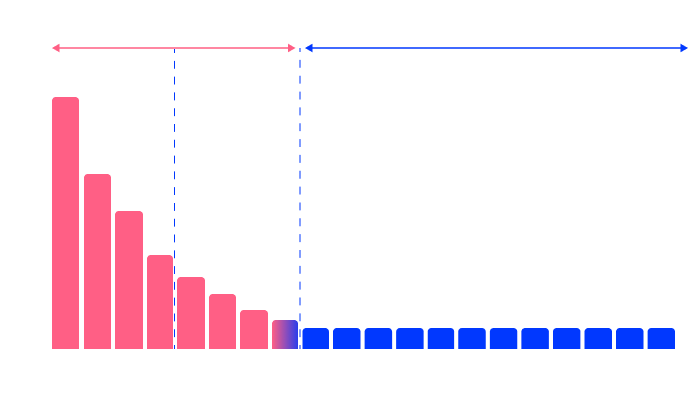
Most teams focus on a short list of priority keywords. They miss the far larger volume of specific searches underneath, which AI tools now draw on to build their answers.
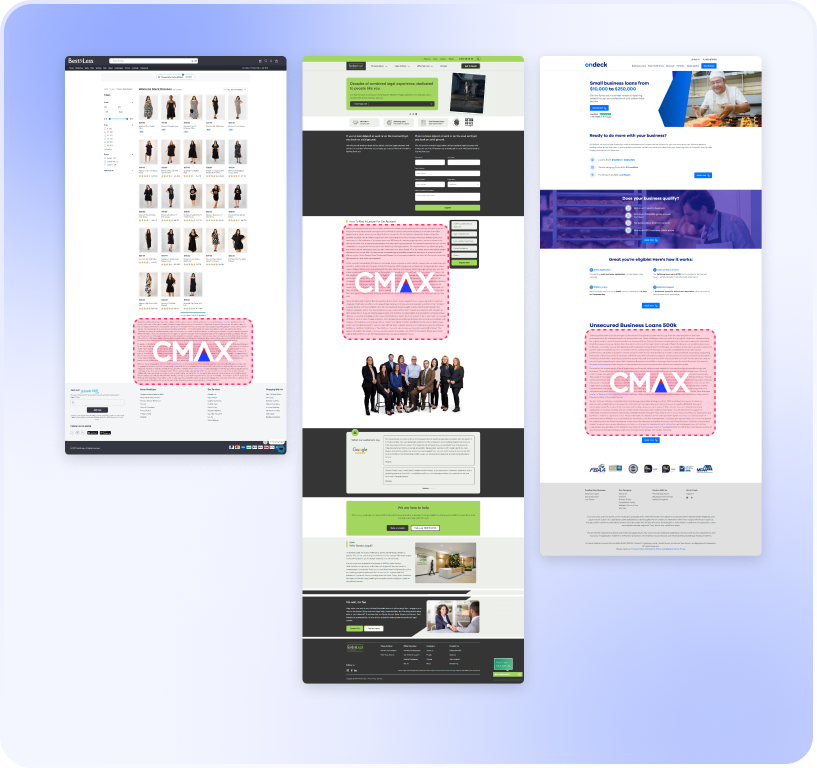
We work on that gap. CMAX helps enterprise teams widen long-tail coverage and keep pages connected and current as search and AI-assisted demand shifts.
Web search optimisation starts with a site that’s easy to crawl and index
At enterprise scale, web search optimisation begins with crawlable text links to every important product, category and advice page. Google works in stages: it crawls, then indexes, then serves results.
Google says not every page makes it through each stage. So each of those pages needs a normal text link from at least one relevant page on your site.
Without one, it can’t compete for demand.
Picture an airport where a plane only counts as arrived once it’s on the arrivals board. Google’s crawler is the ground crew walking the airfield, the index is the board, and a plane parked in a far paddock with no taxiway never gets noticed, let alone listed.
You fix that by building a taxiway from a plane already on the board. In this context, crawlable internal links means a taxiway from a page Google already lists to each product, category and advice page, so the crew can reach it and put it on the board.
Technical setup shapes visibility
Technical SEO decides how much of your site can enter Google’s index, which is the record of pages Google knows about. Good search engine optimisation companies use the same logic to find which revenue-relevant pages aren’t being found, indexed or revisited often enough, and what blocks them.
Common blockers are robots rules, duplicate URLs, broken templates and content hidden behind filters. That is why web design and search engine optimisation need planning together: a template that hides links from Google undoes good content.
A three-day on page SEO analysis can expose blocked URLs, duplicate templates and content hidden behind filters before implementation begins.
Strong visibility depends on content coverage, freshness and connected pages
Long-tail coverage wins discovery
Most teams over-focus on obvious head terms like “casserole dish” and miss where demand lives: specific searches like “best enamel casserole dish for induction cooktop”. An effective B2B SEO strategy goes past priority terms and answers specific questions through comparison pages, FAQs and buying guides.
For website search optimisation, content surface area is the measure that matters: how many of the ways customers search you have a useful answer for.
AI has widened that gap. One AI question can trigger several smaller Google queries, so web search optimisation has to cover the specific needs behind the original question.
AI engines retrieve from Google. The brands that show up in AI answers are the ones covering the specific searches behind the question.
Freshness, breadth, connected pages
Any attempt to define search engine optimisation has to account for the fact that content ages. A repeatable on page SEO process revisits changing prices, ranges and competitor coverage instead of leaving last year’s pages untouched.
Any SEO DIY guide says to refresh old pages. A local SEO strategy follows the same rule, with fresh content and a link to each store or area page.
Google’s crawl frequency also tends to reflect how often a site publishes and updates useful content.
Internal links matter as much. Google recommends that every page you care about has a link from at least one other page on your site, and that related resources link to each other in context.
Unlike isolated technical fixes, web search optimisation connects category pages, buying guides, comparison pages, FAQs and product pages into clear topic areas, which helps your website rank better. On an enterprise site, that structure stops important pages sitting alone.
CMAX helps enterprise teams scale search and AI visibility with an agentic approach
Agentic SEO for connected coverage
CMAX is the Agentic SEO Platform. CMAX is trained on human-reviewed, client-approved content.
A scalable AI SEO strategy needs approved brand material, performance analysis and Dynamic Internal Linking. Uncontrolled content generation has no place in it.
Programmatic SEO publishes from fixed templates and then leaves the pages alone. A practical LLM SEO strategy covers the detailed Google queries AI engines retrieve when they build answers from ranked pages.
Our agents analyse performance, refresh content and strengthen internal links as demand changes.
Built for thousands of searches
Over 90% of search and AI demand is in the long tail. For enterprise teams, the limit is execution.
We define scalable web search optimisation as expanding long-tail coverage while refreshing content and strengthening internal links as demand changes. That suits organisations where manual production can’t keep pace with the pages, updates and links needed to compete beyond a small set of priority keywords.
Frequently Asked Questions (FAQ)
How long does SEO take to show results?
Under any sensible search engine optimisation definition, the work is ongoing, so there’s no fixed timeline. A useful SEO strategy checklist covers continuing improvements to content, links and technical foundations.
Progress depends on the site, its competition and how the work is done. Google says some changes may take effect in a few hours while others can take several months, and it recommends waiting a few weeks before assessing results.
Most SEO programmes run by conventional agencies, using outdated methods, tell clients to expect results in six months. CMAX’s methods allow clients to start seeing clicks in 6 to 8 weeks.
Does paying for Google Ads help organic results?
No. Google doesn’t accept payment to rank pages higher, and ranking is done programmatically. Paid search helps you test copy, find high-converting queries and create demand, but it doesn’t buy organic results.
Web search optimisation builds durable visibility in unpaid search and AI-assisted results.
Does duplicate content hurt SEO at large scale?
At large scale, duplicate content is a crawl and canonicalisation problem before it becomes a penalty. A canonical URL is the one version of a page you want Google to treat as the main one.
Faceted navigation, tracking parameters, regional variants and repeated product copy can produce thousands of near-identical URLs. Google recommends specifying canonical URLs to consolidate signals and avoid wasting crawl time.
Core on page SEO steps include selecting canonical URLs, handling parameters and linking consistently to the preferred version of each page. Enterprise web optimisation tools should help teams manage canonical URLs and crawl efficiency across thousands of regional, filtered or parameter-based pages.
Disciplined canonicals, redirects, parameter handling and consistent internal linking support both conventional visibility and generative search optimisation, because they clarify which version of a page should count.
Web Search Optimisation Starts With Crawlable Coverage
Web search optimisation only works when important pages can be found, indexed and connected to the rest of the site. For enterprise teams, the limit is rarely one big keyword.
It is whether the site has useful coverage for the thousands of specific searches customers make.
That is the problem CMAX is built around. Our website optimisation service expands content coverage and refreshes ageing pages.
It also strengthens internal links using real performance data. The site then keeps pace with changing demand across search and AI-assisted results.
In practical terms, search engine optimisation means building useful coverage for demand and keeping it current and connected as the site grows. Past a certain size, coverage gaps are hard to spot by eye.
A map of where customers search and your site has no answer is the quickest way to see them.
If you’re curious as to how you’re performing on AI, book in a Missing Customer Map review with our Growth Team.
Author
Jeremy Tang
Founder and CEO of CMAX
Jeremy Tang is the Founder and CEO of CMAX. With over 2 decades of experience in business consulting and digital marketing, he has successfully driven seven startup businesses, six of which achieved $1 million in revenue from zero in less than 16 months, 5 of which grew to multi-million dollar a year ventures without any external funding. Jeremy's expertise lies in streamlining business processes through technology and leveraging digital (in particular SEO) for business growth. He resides in Australia, travels extensively, and draws inspiration from his global experiences.