SEO for retailers covers more ground than most ecommerce advice accounts for.
Standard ecommerce SEO stops at the product page. Effective retail SEO also reaches store discovery, local stock, category comparison and fulfilment questions.
Each of those searches needs a different kind of page. Miss any of them and you lose the customer before they ever click through.
Because that demand spans thousands of detailed questions, SEO for ecommerce stores requires broader coverage than a handful of obvious phrases. CMAX is built around this problem, helping retailers expand coverage across store, category and product pages without needing a bigger team.
SEO for retailers helps shoppers find stores, categories, and products.
Search visibility across retail intent.
Retail search intent is not one thing. Store discovery, category browsing, product comparison and fulfilment questions are four distinct reasons someone types something into Google, and each one needs a different answer.
Retail SEO connects those answers to the moment each shopper needs them. Standard ecommerce SEO often stops at product pages and leaves the rest unanswered.
Content surface area drives coverage.
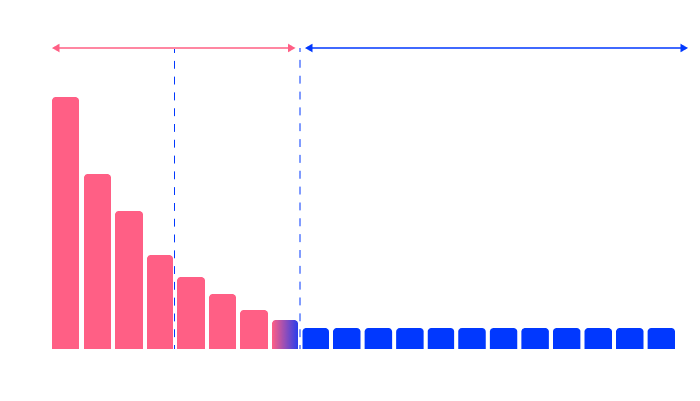
Think of your content surface area as the number of questions you have a useful answer for. Over 90% of search and AI demand is in the long tail, meaning the specific, detailed searches people actually type rather than the short general terms.
The win is not ranking for one obvious phrase. It is having a useful answer for more of the queries that lead to category views, store visits and product sales.
The strongest retail SEO pages match local, category, and product intent.
Page types match different retail intent.
A store page needs location, opening hours, directions, parking, click-and-collect availability, delivery zones and in-store services. These are the details a shopper checks before they get in the car, and standard product pages omit all of them.
Category pages target broader buying intent. Product pages cover SKU-level detail: size, price, materials, specifications and availability.
For purchasable products, Google recommends Product structured data, which means hidden labels in a page’s code that tell Google what things are, including stock status, so shoppers can see availability before they click.
Categories lead, products add depth.
Category and collection pages carry the heavier search demand. They match higher-volume queries around product type, room, use case or brand-plus-category combinations.
Product pages supply the detail that closes the sale: variants, specifications, reviews and live availability.
An ecommerce SEO audit can identify faceted URLs that waste crawling. Too many filtered pages, the pages generated when a shopper ticks size or colour filters, slow down how often Google’s software comes back to read your site.
That slows discovery of the category pages that carry the real demand.
CMAX is the Agentic SEO Platform for scaling retail coverage.
CMAX expands long-tail retail coverage.
Here is where most retail SEO stalls. Retailers protect their brand and category head terms well.
The product-level and local searches that actually convert go uncontested and uncovered.
Think of your site’s search coverage like a product catalogueue in a physical store. The main aisle signs point to the big departments, and most visitors find those without help.
But the purchases happen further in: a specific shelf, a niche brand, a product variant stocked in only two locations. Those items exist whether or not anyone has put a sign pointing to them.
Building long-tail SEO content is the work of putting up the signs, so shoppers who already know what they want can find it directly.
In this context, a scalable ecommerce SEO strategy means building content for those uncontested routes, the specific queries no competitor has answered, so your pages become the default destination when Google has nothing better to show.
CMAX is the Agentic SEO Platform. CMAX is trained on human-reviewed, client-approved content, so the platform supports ecommerce product SEO with approved product knowledge, category rules and brand language, while reaching the vast majority of search demand in the long tail that most retail sites have never touched.
Brands that rank at the top of their most important terms rarely capture more than 5% of the organic search opportunity in their category. Nike ranks at the top for running shoes in the US, yet according to SEMrush it captures around 70,900 visitors a month from non-brand searches related to running shoes, out of more than 8.5 million monthly US searches in the category.
That is under 1% of the actual search demand, for the most dominant brand in the market both offline and online. The opportunity is not at the top of the mountain.
It is spread across thousands of queries nobody has answered yet.
Freshness and linking keep pages connected.
Dynamic Internal Linking makes enterprise ecommerce SEO manageable by connecting related store, category and product pages. This lets Google read your site structure at scale and helps shoppers move from discovery to purchase without hitting a dead end.
Full Body SEO and ongoing content refreshes keep product and collection pages current as stock levels, fulfilment options and seasonal ranges shift. Publishing creates the first version.
Content momentum is what drives organic performance over time.
Retailers on Shopify can explore shopify SEO services to see how the platform scales across large catalogueues. For stores managing thousands of SKUs, shopify SEO covers the specific crawl and content patterns that affect Shopify architecture.
Frequently Asked Questions (FAQ)
How do you handle SEO for product pages that go out of stock?
Keep the URL live. Update the page with the current stock status and surface close substitutes so shoppers still find something useful.
Google supports availability markup on product pages, so you can signal “out of stock” without pulling the page down and losing whatever authority it has built.
If the product is permanently discontinued, redirect to the closest replacement or parent category. That preserves the page’s value rather than leaving a dead end for both shoppers and Google.
This applies whether you are managing SEO for an online store on Shopify or any other platform.
How can retailers avoid duplicate URLs for the same product?
Pick one stable product URL. Keep internal links, XML sitemaps and canonical tags pointing to it consistently.
Colour, size or sort parameters should never generate competing URLs that confuse Google about which page to rank. Google recommends self-referencing canonicals on indexable pages.
Stable canonical tags strengthen SEO for online retailers by preventing filter parameters from creating competing product URLs that split your ranking signals.
Should retailers index filtered category pages?
Only index a filtered page when it matches a real search pattern with distinct value, such as a high-volume brand-plus-size or material-plus-category combination. Google advises blocking crawling of faceted URLs you do not need indexed, because overcrawling slows discovery of the pages that actually drive organic performance.
A note on geography: Google can return different local results for ecommerce SEO Australia than it does in the US. Product pages also need the appropriate dollar currency context to serve Australian shoppers correctly.
CMAX works with businesses across retail and other regulated or specialist sectors, including SEO for healthcare, SEO for banks and SEO for financial services, where content accuracy and coverage depth matter as much as they do in retail.
For retailers watching AI tools like Gemini recommend brands in shopping responses, a gemini SEO service and gemini SEO cover how to build visibility in that channel.
SEO for Retailers Starts With Category Coverage
SEO for retailers works best when category pages carry the main load and product pages add the detail that helps shoppers choose. If you do not have useful content for the many ways people search, you miss demand that was already there, sitting in queries your competitors have not bothered to answer.
Retail visibility spreads across store, category, product and fulfilment intent. Ecommerce SEO marketing connects to sales when fresh content covers those intent types and keeps pace with stock, range and season changes.
This is what an ecommerce SEO agency built for scale does differently from a team optimising one page at a time.
Ecommerce SEO best practices point in the same direction: coverage depth, content freshness and internal linking working together. The ecommerce SEO tips that actually move revenue are not about the obvious head terms.
They are about the thousands of queries your shoppers are already typing that you have no answer for yet.
The straightforward way to find out where your gaps are is to see what searches you are currently missing. The diagnostic does the work.
If you’re curious as to how you’re performing on AI, book in a Missing Customer Map review with our Growth Team.
Author
Jeremy Tang
Founder and CEO of CMAX
Jeremy Tang is the Founder and CEO of CMAX. With over 2 decades of experience in business consulting and digital marketing, he has successfully driven seven startup businesses, six of which achieved $1 million in revenue from zero in less than 16 months, 5 of which grew to multi-million dollar a year ventures without any external funding. Jeremy's expertise lies in streamlining business processes through technology and leveraging digital (in particular SEO) for business growth. He resides in Australia, travels extensively, and draws inspiration from his global experiences.