How to rank in AI Overviews starts with a simpler question: does your page already meet Google’s normal search standards?
Google has confirmed there is no separate technical trick for AI Overviews. No special file, no hidden markup, no schema type that unlocks placement.
What is search engine optimisation, at its core, is helping Google find your page, read it, and decide it answers the question someone typed. AI Overviews run on the same logic.
What actually matters is whether a page is crawlable, well-indexed, and genuinely answers the specific question someone searched, especially the long-tail searches (the specific, detailed queries people actually type, as opposed to short general terms) that make up most search demand. Effective AI search optimisation rests on those three things.
Everything else is noise until those three are solid.
Search Console now gives a clearer picture of AI search visibility, with its generative AI performance report breaking out impressions for AI Overviews and AI Mode by page and country. The AI search visibility optimisation picture is now measurable in a way it simply was not two years ago.
CMAX works from that same Search Console data, using it to decide which existing pages need expanding so they stay eligible as search behaviour shifts.
AI Overviews favour pages that already satisfy search intent
Eligibility basics
For a page that is already indexed and eligible to show a snippet in Google Search, how to rank in AI Overviews begins with clear answers to specific questions.
A page must be indexed and eligible for a standard Search snippet before it can appear as a supporting link in an AI Overview. No separate AI requirement exists beyond that.
A sound AI search engine optimisation process checks whether Google can crawl the page, identify its answer, and surface it for the underlying query. The AI search engine optimisation tools worth using check exactly those signals, not vanity metrics from third-party leaderboards.
The first check is always the same: can Google find the page, read what it answers, and trust it enough to show it?
Crawlability still wins
Google states that standard SEO best practices apply to AI Overviews, with no special optimisations required beyond Search fundamentals. Google places Google AI overviews SEO firmly within those fundamentals, without requiring a special file, technical shortcut, or dedicated schema type.
Here is where a lot of SEO advice goes wrong. Someone adds a schema tag to their page, their impressions go up the following week, and the tip spreads across the industry as fact.
Picture a village where the chickens start dying and someone notices they forgot to brush their teeth that morning. By the end of the month, everyone in the village brushes twice a day to protect the livestock.
That is how a meaningful share of SEO advice gets made: one person sees a change after doing something and assumes one caused the other. In this context, AI search optimisation means testing whether a change actually moved a signal before building a process around it, not repeating a ritual because someone else said it worked.
Hidden AI files, prompt hacks, or one-off experiments will not move the needle if the page is blocked, thin, outdated, or fails to answer the exact question being asked. How to rank in AI Overviews comes back to crawlable, current pages that directly answer the detailed question behind each search.
Standard SEO signals still shape AI visibility, but freshness and coverage matter more than myths
Schema, formatting, and linking
Within an AI visibility platform, structured data (hidden labels in a page’s code that tell Google what things are), answer-first formatting, and strong internal linking help Google extract your answer faster and connect it to related topics on your site. To optimise content for AI search, these signals support eligibility under standard Google requirements without guaranteeing placement.
The goal is the same whether you’re thinking about standard search positions or AI benchmark ranking: give Google a page it can read, trust, and retrieve.
Coverage beats prompt tracking
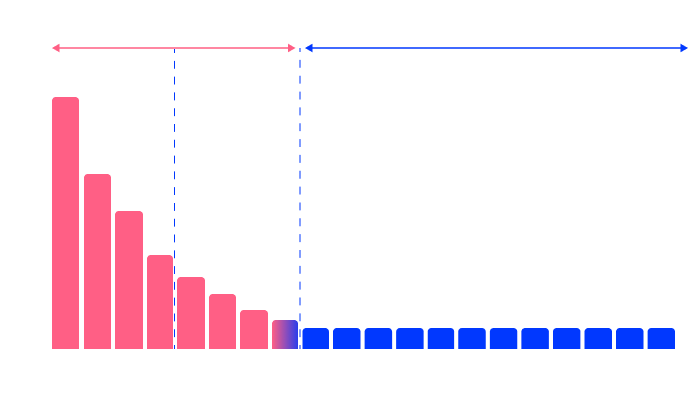
Google confirms you do not need AI-specific files or special markup to appear in AI Overviews or AI Mode. Over 90% of search and AI demand is in the long tail, so broader content surface area, continuous updates, and Search Console impression data do more to show teams how to rank in AI Overviews than prompt tracking or workarounds.
The AI overviews Google search console report is the most reliable signal available for tracking which pages are gaining or losing eligibility.
CMAX supports AI brand visibility by expanding the number of commercial pages that can answer those detailed queries. Many AI search engine optimisation tools measure brand mentions and AI leaderboard positions. CMAX reports on Search Console coverage, search movement, and revenue from commercial pages.
CMAX turns those signals into a system that keeps pages visible
How to rank in AI Overviews depends on crawlable collection pages, Dynamic Internal Linking, and updates informed by Search Console, not prompt tracking.
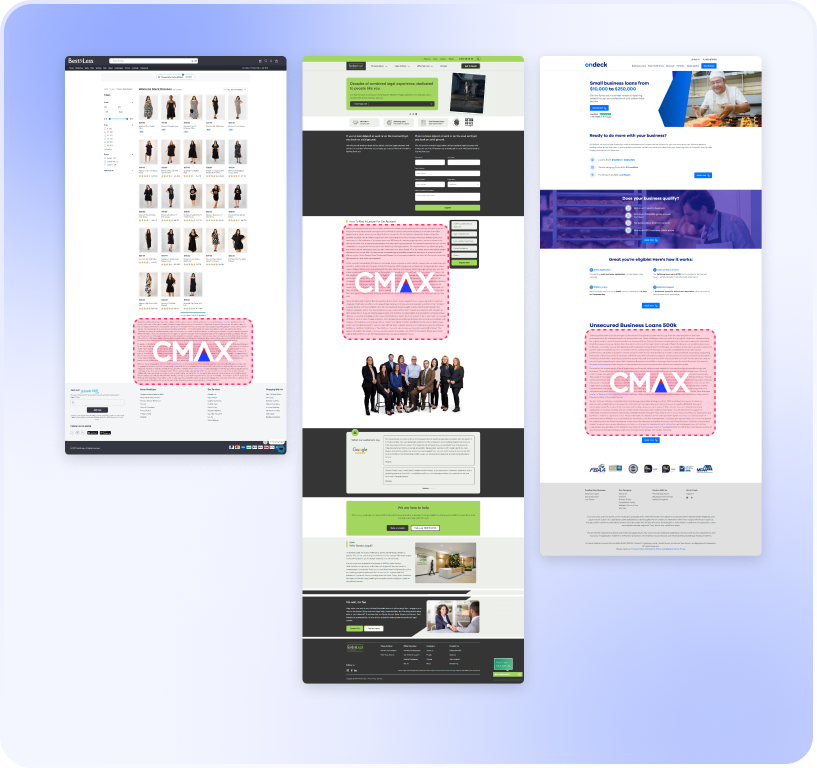
Rather than publishing thousands of standalone articles, CMAX extends the content on the pages that already drive revenue, merchandising, and internal site structure.
Search Console-led momentum
Search Console’s dedicated generative AI performance report delivers impression data for AI Overviews and AI Mode, broken out by page, country, date, and device. Country reporting for Google AI overviews Australia separates local impressions from US results, which makes it precise for spotting where demand is rising and which pages need a refresh.
CMAX feeds that signal into Dynamic Internal Linking and ongoing page updates to keep content current as search behaviour shifts. Publishing creates the first version.
The system that keeps reading Search Console and updating pages is what keeps you visible.
CMAX approaches AI search visibility optimisation through Search Console coverage, search movement, and revenue. Competitive AI visibility benchmarking adds a market-level view, so you can see how your coverage compares to competitors, not just your own history.
Frequently Asked Questions (FAQ)
Can a page appear in an AI Overview without ranking on page one?
A page can appear as a relevant link in an AI Overview under the same broad Search fundamentals, with no page-one-only rule. The factors behind how to rank in Google AI overviews include close question matching, clear answers, snippet eligibility, and a site Google crawls regularly.
How long does it take to rank in AI Overviews?
There is no fixed timeline. Google’s eligibility guidance defines how to rank in AI Overviews through standard crawling, indexing, snippet, and content-quality requirements.
Visibility depends on crawlability, indexing, query fit, and topic competition. Clients see first clicks in 6-8 weeks, with programmes maturing around month six, though AI Overview inclusion can happen earlier or later depending on content strength and freshness.
Do AI Overviews reduce organic clicks?
They can reduce clicks on informational queries while impressions rise, and the AI Overview Google search console report tracks both. With AI Overviews reaching more than 2.5 billion users monthly and AI Mode passing 1 billion (Google figures reported by TechCrunch, May 2026), the practical priority is improving eligibility where search behaviour is already moving.
How To Rank In AI Overviews Starts With Coverage
How to rank in AI Overviews is usually framed as a new AI tactic. The stronger read is simpler: Google still surfaces pages that answer the query clearly, and broader coverage gives it more chances to find the right page.
That is where CMAX fits. CMAX is trained on human-reviewed, client-approved content and addresses Google AI Overview SEO impact by expanding useful content on commercial pages and updating it as Search Console demand shifts.
CMAX targets the vast majority of search demand sitting in the long tail, the searches your competitors are not covering and your current site is not answering.
For teams watching Search Console, impressions often show up before a manual review ever will. More content surface area, stronger internal connections, and ongoing page updates support AI ranking by giving search and AI systems more useful material to retrieve.
AI visibility grows when more of the specific ways customers search are answered by current, crawlable pages.
The most useful next step is finding out where your gaps actually are.
If you’re curious as to how you’re performing on AI, book in a Missing Customer Map review with our Growth Team.
Author
Jeremy Tang
Founder and CEO of CMAX
Jeremy Tang is the Founder and CEO of CMAX. With over 2 decades of experience in business consulting and digital marketing, he has successfully driven seven startup businesses, six of which achieved $1 million in revenue from zero in less than 16 months, 5 of which grew to multi-million dollar a year ventures without any external funding. Jeremy's expertise lies in streamlining business processes through technology and leveraging digital (in particular SEO) for business growth. He resides in Australia, travels extensively, and draws inspiration from his global experiences.