Answer engine optimisation, or AEO, makes your pages easy for AI systems to retrieve and cite. On an enterprise site, that means clear answers across thousands of product, category and advice pages.
Enterprise LLM visibility depends on publishing direct, accurate answers well beyond a handful of priority pages.
You manage thousands of pages, not one. Few people in the building have read all of them.
Most were never written to answer a specific buyer question directly. Strong LLM search visibility needs useful answers for the specific ways buyers ask.
Google has said its AI features still pull from the same core Search systems that rank pages today. So the sites that show up in AI answers are usually the ones that already have clear, useful content for the exact way people search, at scale.
This is a coverage problem before it is a formatting problem. Picture a librarian handed a visitor’s question on small sofas.
She walks to the shelf and pulls the book that answers it. Your site is one shelf: if it holds three general books on sofas and none on modular sofas for small apartments, she walks to another library’s shelf.
In this context, answer engine optimisation means putting a book on your shelf for each specific question your buyers ask, so the librarian has something to pull. Closing that gap is where a generative search optimisation agency can add value, expanding long-tail content across collection and category pages so AI systems have more relevant material to retrieve.
Answer engine optimisation helps AI systems retrieve usable passages while SEO still matters
AEO complements SEO. It does not replace it.
Google’s generative AI features are rooted in core Search ranking and quality systems, pulling relevant pages from Google’s index before generating any response. That makes AEO a commercial question first: do you have a clear, useful page for each specific way buyers ask about what you sell?
Clear answers improve retrieval
AI systems are more likely to use passages that answer one question directly. If someone asks what is generative engine optimisation, a good page answers in one paragraph that an AI system can retrieve, summarise and cite.
A concise answer may also win a featured snippet, but indexation and long-tail coverage still decide whether Google considers the page. For an enterprise site, that means turning buried sales copy into extractable answers: define the product category, explain who it suits, compare options, state limits and address objections in plain language.
A practical test: could one paragraph be quoted in an AI answer without the surrounding page to explain it?
SEO still sets the ceiling
Google’s generative AI features rely on core Search ranking systems to retrieve pages. Weak indexation, thin category pages and missing long-tail coverage limit whether your content is considered at all.
A high position doesn’t automatically earn citations. If your site has no useful page for “best modular sofa for apartment living,” an AI answer looks elsewhere.
In practice, generative engine optimisation improves a page’s eligibility for AI answers, and SEO gives that page a realistic chance of being found.
CMAX focuses answer engine optimisation on what raises visibility at scale
Most AEO advice fixates on formatting: structured data markup and tidy answer boxes. Google has stated directly that no special schema markup is required for generative AI search.
Optimising for those signals targets the wrong thing. We apply answer engine optimisation through broader useful coverage and stronger connections between related pages.
We also keep that content current.
Long-tail coverage matters most
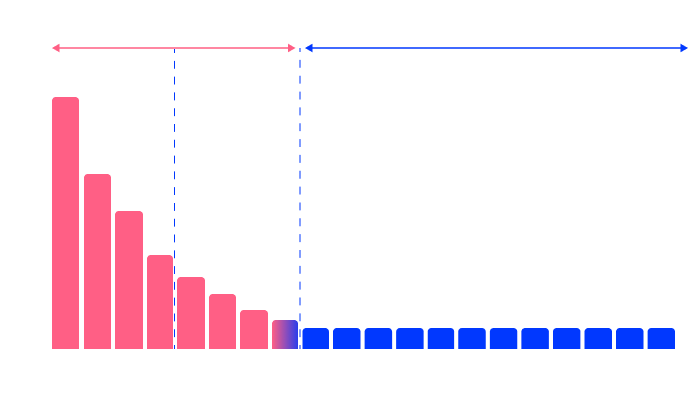
Over 90% of search and AI demand is in the long tail. These are the specific, detailed queries buyers type when they’re close to a decision.
A retailer can have a strong homepage and still lose search and AI visibility when detailed buyer questions about fit, comparison, risk and timing have no useful answer anywhere on its site. You can’t rank for something you don’t talk about.
CMAX targets the long tail
CMAX targets the long tail, where most search demand sits. This is how we optimise content for AI search: content injection, Dynamic Internal Linking and Full Body SEO.
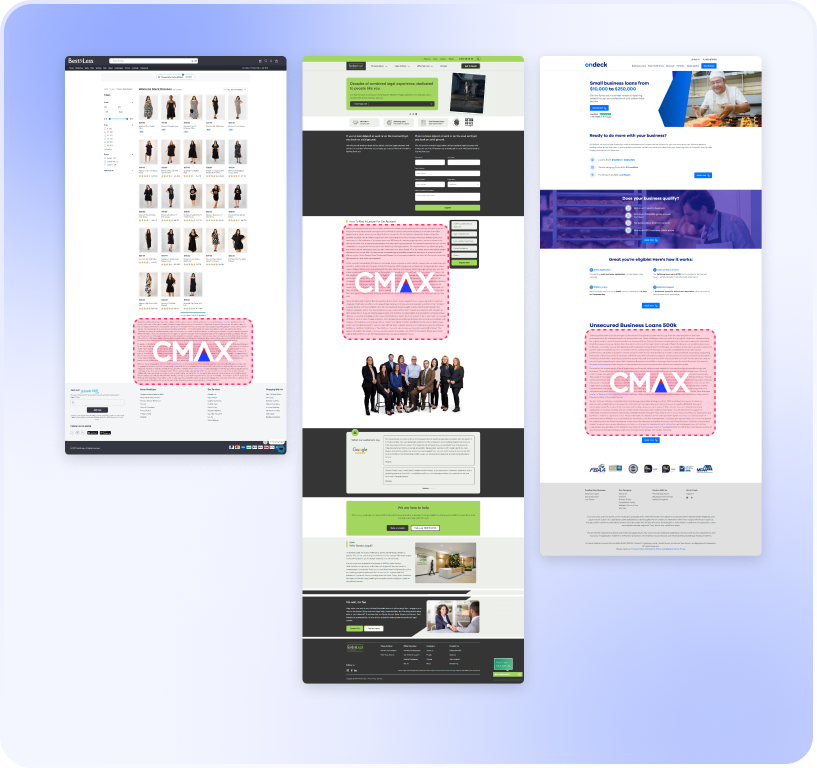
Content injection places useful answers directly on the pages buyers already visit: category, product, location, comparison and advice pages. Dynamic Internal Linking connects related pages so Google can map how they support each other.
A capable generative engine optimisation agency should expand the whole content surface area and cover more of the ways customers search, instead of relying on a handful of priority pages to carry the programme.
CMAX keeps answer engine optimisation current with freshness, connected pages and measurable coverage
AI visibility shifts constantly. Keeping LLM brand visibility up means updating as new searches appear, product language changes, competitors publish and once-useful pages go stale.
We use answer engine optimisation alongside SEO, as an ongoing operating system for search and AI visibility.
Surface area grows with updates
Content surface area grows when teams add new pages, expand thin sections and cover adjacent query patterns. AI tools can run eight to 12 related Google searches from a single buyer question and build their answer from what ranks across all of them.
Treat generative search optimisation as a coverage discipline. The brand with useful answers across those angles has more chances to appear in the final response.
CMAX updates from performance data
We can optimise for AI overviews by using Search Console and ranking data to decide what gets updated next. CMAX is trained on human-reviewed, client-approved content.
Google’s Generative AI performance report in Search Console shows which queries surface your content through AI features. That supports a repeatable workflow: find underperforming queries, improve the page answer, strengthen internal links, then track whether visibility and clicks move.
Pair it with LLM visibility tracking, using whichever LLM visibility tracker or LLM visibility checker you prefer, to see whether the changes land.
Frequently Asked Questions (FAQ)
How long does answer engine optimisation take to show results?
Answer engine optimisation is the discipline we use to make enterprise content retrievable and citable by AI systems. Timelines for generative engine optimisation depend on the site, its competition and how the work is done.
Assessments of the best LLM visibility tracking tools and the best generative engine optimisation tools should examine coverage expansion, internal connections and updates driven by performance data.
Can anyone promise my brand will appear in AI answers?
If you’re asking why is generative engine optimisation important, the answer is eligibility: clear original answers improve it without promising inclusion. AI answer systems rely on Google’s core ranking and quality systems to retrieve pages, so inclusion is never certain.
What you can improve is eligibility. Publish clear original answers, cover the detailed searches buyers actually use, make related pages reinforce each other and keep content accurate.
What sources do AI answer engines cite besides my website?
Third-party publishers, review sites, marketplaces and forums are all fair game. Whether the input is a detailed buyer question or a clipped instruction such as search engine optimisation define, Google’s generative AI features show prominent, clickable links to any pages their retrieval systems judge relevant.
The practical job is to make your own site the clearest source for your products, categories and buyer questions, while knowing which outside sources already shape the answer. Clear product, category and buyer-question pages make answer engine optimisation a sustainable coverage discipline.
Answer Engine Optimisation Starts With Search Coverage
Answer engine optimisation works best when it builds on what Google and AI systems both rely on: useful pages for specific buyer questions. That is why we start with coverage, especially across the long tail where most demand sits.
CMAX is the Agentic SEO Platform. We apply AI in search engine optimisation to help brands expand the number of ways they can be found, connect related pages and keep content current, so search and AI systems have more relevant material to retrieve.
You still can’t show up for searches you don’t answer. Better visibility usually comes from generative engine optimisation services that build enough clear, current content across the category, and less from formatting tricks.
A review shows which buyer questions your site answers today and which it leaves blank. It is the quickest way to see where the gaps sit.
If you’re curious as to how you’re performing on AI, book in a Missing Customer Map review with our Growth Team.
Author
Jeremy Tang
Founder and CEO of CMAX
Jeremy Tang is the Founder and CEO of CMAX. With over 2 decades of experience in business consulting and digital marketing, he has successfully driven seven startup businesses, six of which achieved $1 million in revenue from zero in less than 16 months, 5 of which grew to multi-million dollar a year ventures without any external funding. Jeremy's expertise lies in streamlining business processes through technology and leveraging digital (in particular SEO) for business growth. He resides in Australia, travels extensively, and draws inspiration from his global experiences.