An AI answer SEO strategy comes down to one question: can customers find your brand whether they search on Google or ask an AI engine?
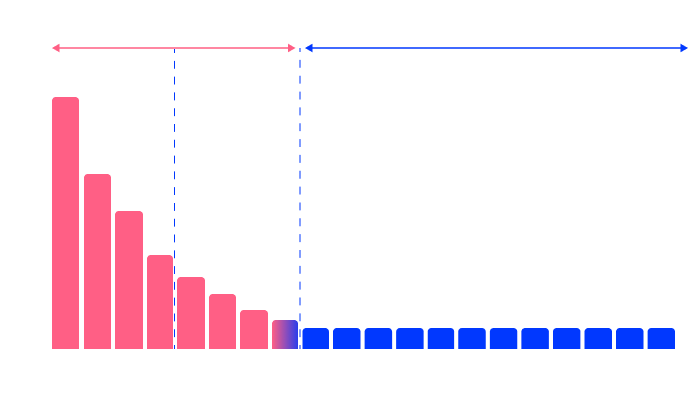
Most of that demand sits in the long tail, the specific, detailed searches people type before they buy, not the handful of broad terms your marketing team usually targets. Even Nike, ranking first for “running shoes” in the US, captures under 1% of actual search demand in its category.
The opportunity is in the questions beyond the obvious ones.
Google has confirmed that the same SEO fundamentals apply to AI Overviews and AI Mode. There is no separate AI playbook.
Better coverage of the questions customers already ask is what drives inclusion in both. That is what generative engine optimisation means in practice: foundational SEO applied to content that AI systems can retrieve, interpret and cite.
If you’ve been asking what is generative engine optimisation, that is the answer.
CMAX works from Search Console data to show which of those questions your site already answers and where the gaps remain. Search Console is Google’s free tool showing which searches your site appears for.
It also shows what answer engine optimisation means in practice: the specific questions already surfacing your site, and the ones that aren’t. Understanding what is answer engine optimisation matters here because it reframes the goal from chasing broad terms to covering the questions customers actually ask.
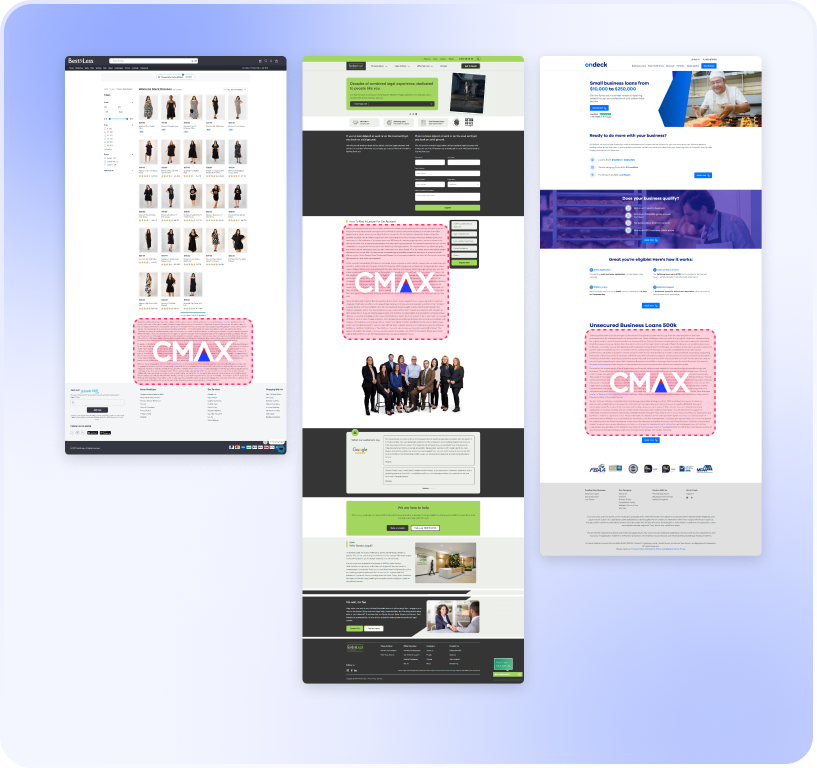
For large catalogueues with filtered views, faceted navigation SEO determines which of those filtered pages should be indexable, each with a distinct, useful answer of its own.
AI answer SEO strategy helps brands show up in search and AI answers across the long tail.
Why long-tail demand matters
A focused AI answer SEO strategy maps specific long-tail questions to answer-first pages that support visibility in Google and AI-generated answers.
Here is where it gets counterintuitive. When a customer asks an AI engine a question, that engine does not just run one search.
Think of a menu at a restaurant: one order triggers the kitchen, the bar, the supplier list and the allergen register before anything reaches the table. One request, many lookups.
In this context, query fan-out means one prompt to an AI engine runs a dozen or so background searches, and your brand has to appear across those searches, not just the obvious one, to make it into the answer.
That is why a generative engine optimisation agency maps topic clusters rather than single keywords. Covering the surrounding questions carries more weight than optimising one page for one phrase.
Answer-first pages support inclusion
Answer-first pages lead with the clearest answer, then layer in the proof, examples and trade-offs a buyer needs before they trust it. That structure works for a skimmable AI response and for a person reading the detail.
Effective answer engine optimisation services build each page around a clear response, supporting evidence, practical examples and relevant trade-offs.
While a link building SEO service concentrates on off-site authority, Google confirms the same SEO fundamentals apply to AI Overviews and AI Mode, with no special markup required. That is why this approach works best when answer engine optimisation aeo, generative engine optimisation GEO and standard SEO run as one connected content system rather than three separate retainers.
CMAX combines coverage, freshness, and Search Console-led measurement into one service.
Connected coverage for customer questions
For a homewares retailer, AI overviews SEO can mean separate pages for product comparisons, size guides, care instructions, use-case searches and “best for” queries. Each page answers one specific question.
One broad page trying to cover all of them answers none of them well.
That breadth is what we mean by content surface area: how many of the ways customers search you actually have a useful answer behind them. More surface area means more chances to appear in standard results and AI answers alike.
Google reports AI feature clicks inside Search Console’s Performance report under the Web search type, so you are not flying blind. Search Console supplies the data an AI answer SEO strategy needs to find existing impressions and identify the gaps that still need pages.
Freshness, crawl, and internal links
New searches keep appearing. Google AI overviews SEO depends on pages that stay accurate as stock changes or terminology shifts.
Google says eligibility for AI features depends on normal indexing, crawl frequency (how often Google’s software comes back to read your site) and snippet rules. No AI-specific code is required.
Within artificial intelligence SEO, Dynamic Internal Linking connects related pages so Google gains clearer context across the site, and customers can move naturally from one question to the next.
Brands choose CMAX when they want an agentic approach that keeps content useful over time.
Agentic SEO Platform vs agencies
CMAX is the Agentic SEO Platform, reflecting the broader use of artificial intelligence in SEO to scale content production and ongoing refreshes together. Pages do not publish once and quietly age out.
Unlike static programmatic output, an AI answer SEO strategy built through CMAX refreshes weak pages as performance and demand shift.
CMAX is trained on human-reviewed, client-approved content. That means your tone, accuracy and regulated claims stay intact at scale.
Most SEO programmes run by conventional agencies, using outdated methods, tell clients to expect results in six months. CMAX’s methods allow clients to start seeing clicks in 6 to 8 weeks.
Timing still depends on the site, its competition and how the work is done, but the gap between those two numbers is where conventional agencies leave money sitting.
Search Console-led reporting and expansion
A Search Console-led SEO strategy shows which searches already generate impressions, which pages are close to working, and where new content is missing entirely. Teams ACT on actual query data, not guesswork.
Google confirms that sites appearing in AI features are included in overall Search Console reporting, so one dataset covers both search and AI visibility.
Controlled generative AI optimisation uses content closely based on human-reviewed, client-approved material to preserve tone, accuracy and regulated claims. CMAX is trained on that approved material, giving teams scale without losing editorial control.
Frequently Asked Questions (FAQ)
Will optimising for AI Overviews hurt my traditional SEO performance?
No. Work that improves answer clarity, page usefulness and topical coverage supports both traditional search visibility and AI inclusion, as long as pages are built for people first. CMAX defines an AI answer SEO strategy as connected work on answer clarity, topical coverage and the foundational practices Google applies to AI features.
Do AI Overviews reduce website clicks?
They can, particularly when an overview answers a simple question directly on the results page and affects featured snippets. Pew Research Centre found users clicked a traditional result in 8% of visits with an AI summary versus 15% without one.
That is a shift SEO experts must weigh alongside the brand exposure that happens before buyers shortlist or purchase. Feature snippets and SEO AI overviews both require the same assessment: visibility before the click still has commercial value.
Can I opt out of AI Overviews without losing Google search visibility?
Controls like nosnippet, data-nosnippet, max-snippet and noindex can limit how your content appears in AI features. Google states a page must be eligible to show a snippet in standard search to qualify as a supporting link in AI Overviews.
Opting out of AI features can reduce your visibility in both. An AI answer SEO strategy must weigh AI presentation against visibility in standard results before applying any of those controls.
AI Answer SEO Strategy Starts With Coverage
Over 90% of search and AI demand is in the long tail. If your site does not have a useful answer for a question, it will not appear when that question is asked, in Google or in the AI answers built from Google’s index.
CMAX targets the vast majority of search demand that sits in the long tail because that is where most of the opportunity sits, and where most sites have the most gaps. Knowing how to improve your SEO ranking in that space means covering the specific questions customers ask, not just the obvious head terms.
For businesses looking at answer engine optimisation Australia, the same principle applies: the long tail is larger than most teams expect, and most of it goes unanswered.
AI answer SEO strategy also benefits from knowledge graph SEO, which makes the relationships between topics and entities clearer to the systems interpreting your site.
That is why CMAX focuses on content surface area, freshness and Search Console-led decisions rather than separate SEO and “AI visibility” retainers. The aim is practical coverage across the long tail with content that stays current and connected as demand shifts.
Our SEO experts can show you where your site already has coverage and where stronger answers could help. For teams evaluating an answer engine optimisation platform, the question worth asking is whether it connects Search Console data, content production and freshness into one system or treats them as separate workstreams.
The simplest way to see your gaps is a diagnostic review, not a sales conversation.
If you’re curious as to how you’re performing on AI, book in a Missing Customer Map review with our Growth Team.
Author
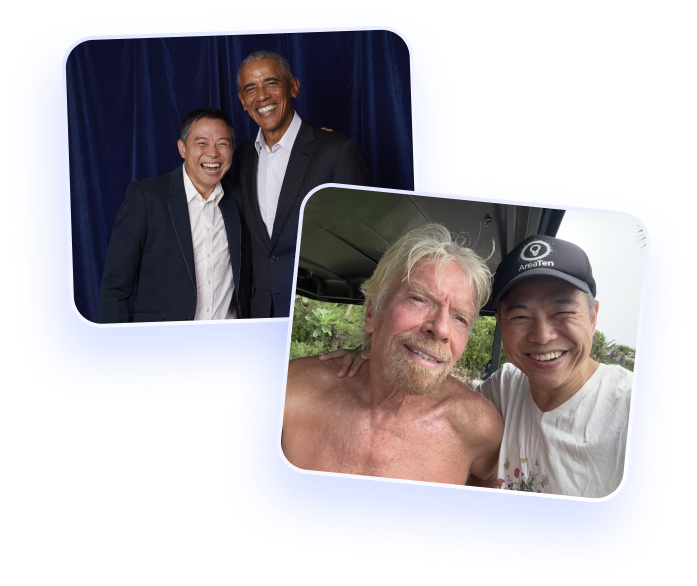
Jeremy Tang
Founder and CEO of CMAX
Jeremy Tang is the Founder and CEO of CMAX. With over 2 decades of experience in business consulting and digital marketing, he has successfully driven seven startup businesses, six of which achieved $1 million in revenue from zero in less than 16 months, 5 of which grew to multi-million dollar a year ventures without any external funding. Jeremy's expertise lies in streamlining business processes through technology and leveraging digital (in particular SEO) for business growth. He resides in Australia, travels extensively, and draws inspiration from his global experiences.