In current search strategy, AEO is the work of helping a brand appear in AI answers as well as traditional search results.
If two vendors have pitched you separate “AI visibility” retainers, your suspicion is fair. A second retainer for the same work is still a second retainer.
Separate retainers can hide AI search optimisation, which still depends on useful site content. It needs no second channel and no special markup.
The short answer is that AEO services are SEO, built to also work for AI Overviews and AI Mode. You don’t need AI search engine optimisation tools or special markup for your brand to be eligible.
What matters commercially is whether your site answers the specific questions your customers type in, long before they compare or buy.
We build and update the page content that gives your brand more chances to be the answer, in Google and in AI.
AEO services help your brand surface in answer-style results
AEO means SEO for answer engines
Effective AEO services adapt SEO for Google’s AI Overviews and AI Mode, where clear answers to specific questions support eligibility alongside traditional results. Anyone asking “What is search engine optimisation?” gets the same answer here: make pages easy to find and useful to read.
If a vendor sells AEO as a separate channel on top of your current SEO spend, the frame is wrong. The work is making your site clearly answer the questions customers ask before they compare, choose or buy.
Google confirms the same foundational SEO best practices apply to AI features in Search. No special schema or separate AI markup is required for eligibility.
Long-tail coverage drives visibility
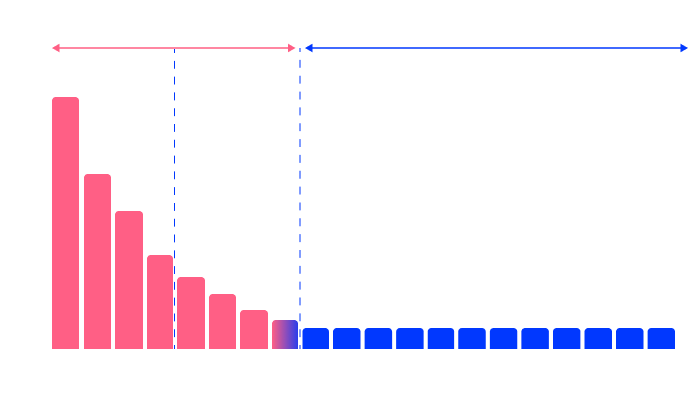
Over 90% of search and AI demand is in the long tail. These are the specific, detailed queries people actually type.
Answer engines don’t rely on broad category terms alone. They need useful answers to queries like “best modular sofa for small apartment with washable covers.”
Google says AI Overviews and AI Mode may use query fan-out, which runs several smaller searches to build one answer. Picture the customer’s question as a jigsaw puzzle the engine has to finish.
The smaller searches are the pieces, and your pages are the boxes it reaches into. A box holding only the lid picture gives it nothing to pick up, and a box full of the right pieces gets used.
In this context, query fan-out means the engine looks on your site for a piece for each smaller search, so the more subtopics your pages cover usefully, the more pieces it can take.
For Australian brands, AEO services Australia planning means mapping those subtopics to useful pages. Answer engine optimisation services work best when each subtopic has a page of its own.
Strong AEO services build the content and signals answer engines use
Structure helps engines understand pages
Good AEO marketing makes pages clear for people and search systems alike. It uses headings that match real questions, concise answers near the top and supporting detail below.
It also uses schema, which is hidden code that labels what a page contains, such as a product, FAQ, review or organisation.
Teams can optimise content for AI search with question-led headings, concise answers and schema, while keeping the supporting detail Google needs. Schema helps Google classify content and show richer results where eligible.
It can’t make up for a page that never answers the query.
CMAX builds long-tail, connected content
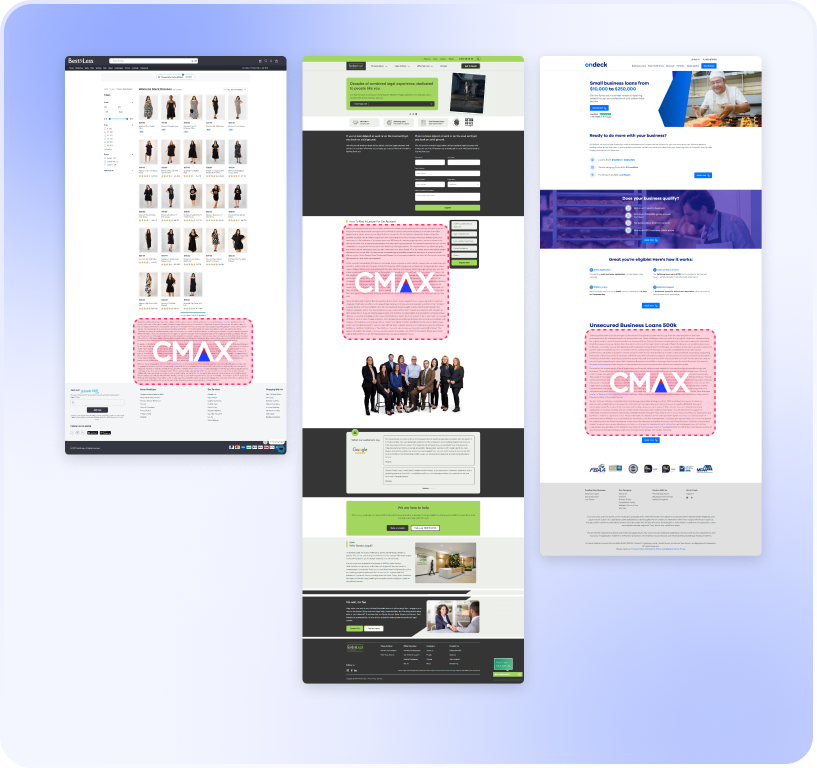
CMAX uses Full Body SEO to deliver AEO services through refreshed category, collection, product and location content. CMAX is trained on human-reviewed, client-approved content.
Dynamic Internal Linking then connects related pages, so Google reads the wider topic context and not each page in isolation. Unlike bulk publishing that stops at launch, our agents check performance signals and update content continuously.
The best AEO programmes stay current and measurable
Search Console and crawl data guide updates
Search Console shows which searches your site appears for. A good AEO programme uses that data to find rising impressions, declining clicks, missing query coverage and pages that attract the wrong searches.
Providers of AEO services in Australia should show you that list. Unlike one-off audits, they use Search Console impressions and crawl data to prioritise the next page update.
A page-level plan for AI search visibility optimisation can use crawl frequency, which is how often Google visits a page, to identify the category pages that drive revenue and need fresher content and stronger internal links. Fresh supporting pages around them can help Google revisit those priorities more often.
Ongoing execution beats one-off audits
A conventional answer engine optimisation agency may deliver an audit. Google’s guidance for AI features points to technical eligibility, indexing and helpful content, which build visibility through steady publishing and updating.
A credible provider should show what content was added, which queries it targeted, what shifted in Search Console and what gets refreshed next.
Content goes stale, new searches keep appearing, and you can’t rank for something you don’t talk about. Ask any provider “What is search optimisation?” in their AI package, and the answer should describe this ongoing work.
Steady publishing, accurate answers and connected pages make AEO services ongoing execution. They don’t add a separate AI channel.
That is where AEO meaning becomes practical.
Frequently Asked Questions (FAQ)
How long does it take to see results from AEO?
Timelines depend on the site, its competition and how the work is done. A provider quoting a fixed number without those caveats is guessing.
Most SEO programmes run by conventional agencies, using outdated methods, tell clients to expect results in six months. CMAX’s methods allow clients to start seeing clicks in 6 to 8 weeks.
Approved content goes onto existing pages, and Search Console data guides what gets refreshed next. Good answer engine optimisation services turn that data into the next approved content refresh.
Why does AI sometimes get my brand’s facts wrong?
AI engines retrieve from Google. If your product descriptions are outdated, key pages are missing from Google’s index, or critical details sit in PDFs instead of live page content, third-party sources fill the gap.
In practice, AEO means getting accurate pages indexed and eligible to show a Search snippet before they can support AI Overviews or AI Mode.
If you’re asking “What is answer engine optimisation?” it starts with current product descriptions, indexed pages and facts Google can retrieve.
Why do AI answers cite different sources for the same prompt?
Google confirms that AI Mode and AI Overviews can use different models and techniques, so citations shift even for closely related searches. The practical response is to build more useful page-level answers and refresh pages gaining impressions.
Connect related pages with Dynamic Internal Linking, and make your brand’s facts easier for Google to retrieve than weaker third-party summaries.
AEO Services Start With Long Tail Coverage
AEO services only move the needle when they expand the number of useful answers your site gives across Google and AI. Brands usually lose to coverage they lack, and rarely to better tactics.
AEO services and long-tail coverage apply across markets. In AEO Australia planning, the market context may vary from the US, while search systems still rely on useful, connected page content.
Documentation for search engine optimisation Australia uses local spelling, and the practical work stays the same: clear answers, current pages and connected content.
CMAX is the Agentic SEO Platform, built to add and update content across the long tail on the pages that already matter to revenue. It also keeps related pages connected, so search systems read your site as a topic set and not a handful of isolated pages.
A review shows which questions your site answers today and which it misses. That gives you a plain list to work from.
If you’re curious as to how you’re performing on AI, book in a Missing Customer Map review with our Growth Team.
Author
Jeremy Tang
Founder and CEO of CMAX
Jeremy Tang is the Founder and CEO of CMAX. With over 2 decades of experience in business consulting and digital marketing, he has successfully driven seven startup businesses, six of which achieved $1 million in revenue from zero in less than 16 months, 5 of which grew to multi-million dollar a year ventures without any external funding. Jeremy's expertise lies in streamlining business processes through technology and leveraging digital (in particular SEO) for business growth. He resides in Australia, travels extensively, and draws inspiration from his global experiences.